Why Full Stack Manufacturing Matters More Than a Camera Spec Sheet
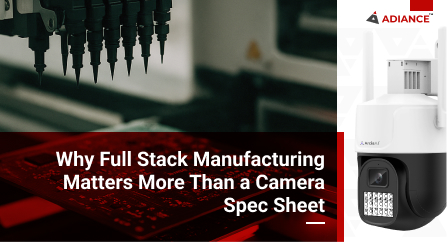
A security camera is no longer a sensor in a metal housing. Behind every reliable camera sits a full manufacturing stack — silicon selection, PCB design, board assembly, firmware, optics, AI, and the software it talks to. The spec sheet shows what a camera does on day one. The manufacturing behind it decides whether it keeps doing it for the next five years, and whether you can trust where it came from. This is why serious buyers, brands, and integrators have stopped asking only "what are the specs and the price?" They now ask two harder questions: Who actually built this, and do they control how it's built? A full-stack manufacturer answers both. A box-assembler usually can't.
What Is Full-Stack Manufacturing?
Full-stack manufacturing rests on two things working together:
- In-house capability across the stack. A genuine manufacturer designs and builds the core layers itself — PCB design and SMT assembly, firmware and embedded engineering, AI and edge processing, and the VMS, cloud, and app software the hardware runs on. Capability isn't outsourced and rebadged; it lives under one roof.
- Ownership and traceability. Building it yourself only matters if you can also account for it. Full BOM (bill of materials) control, a transparent supply chain, and documented component origin mean the manufacturer can prove what's inside every unit — not just describe it.
In short: a spec sheet proves a camera works today. Full-stack manufacturing proves it was engineered, sourced, and built to keep working — and to pass scrutiny.
The Problem With Box-Assembly and Trading-House Models
Much of the surveillance market is built on rebadging. A trading house imports finished boards or whole cameras, prints a logo on them, and sells them as their own. On paper it looks the same. In practice, the gaps show up later:
- No control over firmware, so security patches and feature requests depend entirely on a third party
- No visibility into the BOM, so component changes happen silently between batches
- Compliance exposure when the origin of the silicon or the supply chain can't be documented
- Little or no real customization — you get what the upstream factory already makes
- Inconsistent quality across production runs, with no in-house QA to catch it
- Weak long-term support once the upstream supplier moves on to the next model
When a deployment scales across sites — or across countries with their own procurement rules — these gaps turn into recalls, failed audits, and stranded inventory. In security, a sourcing shortcut becomes a real risk
The Benefits of Full-Stack Manufacturing
Owning the stack changes the economics and the reliability of everything built on it:
- Design control — hardware tuned to a real specification, not whatever the upstream factory had available
- Firmware and security ownership — patches, hardening, and updates issued directly, on the manufacturer's own timeline
- Deep customization — genuine OEM/ODM work, from custom firmware and logo to bespoke hardware, not just relabeling
- Faster iteration — when R&D, SMT, and firmware sit together, a design change is days, not quarters
- Consistent quality — in-house testing and traceability catch defects before they ship
- Compliance certainty — origin, components, and certifications can be proven, not assumed
The result is hardware a brand can stand behind, rather than hardware it hopes will hold up.
Inside the Manufacturing Stack
A full-stack manufacturer is accountable at every layer:
- Silicon / SoC selection — choosing the System-on-Chip that defines a camera's performance, security posture, and compliance status
- PCB design and SMT assembly — laying out and populating boards in-house, with full control of the bill of materials
- Firmware and embedded engineering — the low-level software that turns a board into a secure, reliable device
- Optics and mechanical design — lenses, housings, and environmental hardening for real field conditions
- AI and edge engineering — on-device analytics like detection, recognition, and behaviour analysis
- VMS, cloud, and app software — the platform that ties cameras, recorders, and operators together
- QA, testing, and certification — validating every layer against recognised standards before it ships
Each layer compounds the next. Weakness anywhere — a chip with an unclear origin, firmware nobody controls, untested boards — undermines everything above it.
Supply Chain and Compliance
In regulated markets, the supply chain is the product decision. The chip at the heart of every camera — the SoC — now sits at the centre of procurement scrutiny, because several major Chinese SoC vendors are subject to export controls, sanctions risk, and cybersecurity concern across the US, EU, UK, Australia, and India.
A full-stack manufacturer addresses this at the source:
- Non-Chinese SoC architecture — silicon chosen from trusted fabs rather than restricted-origin suppliers
- NDAA Section 889 compliance — no banned components anywhere in the build
- Traceable BOM — documented, auditable component origin for every unit
- Standardised certification — recognised marks (STQC, BIS, ISO 9001, ISO 27001, CE, FCC, ONVIF) that procurement teams require
For banking, healthcare, defense, logistics, public infrastructure, and government, these aren't bonus features. They are the gate a product passes — or fails — before performance is even discussed.
The Business Value
Full-stack manufacturing isn't only an engineering argument; it's a commercial one — especially for brands and integrators sourcing their own lines:
- White-label and ODM depth — your brand, firmware, packaging, and app, with the IP genuinely protected
- Healthier margins — building closer to the source removes the markups of multi-layer sourcing
- Market access — compliant, documented hardware clears regulated procurement that rebadged product can't
- Faster time to market — one partner who owns design, assembly, firmware, and software, instead of stitching vendors together
- A single accountable partner — one team answerable for the camera, the recorder, the VMS, and the cloud
The outcome is lower long-term cost, fewer surprises, and a product line a brand can actually own.
How to Evaluate a Manufacturing Partner
- A few direct questions separate a manufacturer from a reseller:
- Do they run their own SMT lines and R&D, or assemble imported boards?
- Can they show full BOM control and a traceable, documented supply chain?
- Is the SoC non-Chinese, with NDAA Section 889 and the certifications your market requires (STQC, BIS, ISO, CE, FCC)?
- Do they own the firmware and software, so updates and security come directly from them?
- Can they genuinely customise — hardware, firmware, and software — under your brand?
- Will they support the product, and scale with you, well past the first shipment?
A strong partner builds with you for years, not just for one purchase order.
How Adiance Fits In
Adiance Technologies is built on this exact principle — that trust comes from the manufacturer, not the label on the box. Founded in 2002 and headquartered in Ahmedabad, Gujarat, Adiance is a Make-in-India OEM/ODM camera manufacturer that owns the full stack end to end.
That stack is real, not outsourced:
- In-house R&D and SMT manufacturing lines at its Sanand, Ahmedabad facility, with full BOM control and traceable component documentation
- Non-Chinese SoC architecture — Qualcomm (Snapdragon) for Edge AI, Ambarella for high-performance 4K, and Novatek for cost-optimised models, sourced from trusted fabs
- Firmware, AI, and software built in-house — from PCB assembly and embedded firmware to edge-AI models, Cloud VMS, and mobile apps
- A complete product line — including the S-Series Edge AI cameras, a 5G SIM-based camera, NVRs from 4CH to 32CH, and an STQC-certified VMS — plus PCBs and robotic arms used in its own production
Adiance also meets the standards that decide serious deployments: NDAA Section 889 compliance, STQC certification, BIS, ISO 9001:2015, ISO 27001, CE, FCC, and ONVIF support, backed by membership in ELCINA, ESAI, and GESIA. Cameras are field-rated for harsh environments — up to 60°C ambient, IP67, and IK10 — and the same stack powers its flagship brand ArcisAI as well as white-label lines for 50+ brands across 40+ countries.
In other words, Adiance doesn't ship a spec sheet. It ships hardware it designed, built, and can account for — from the chip to the cloud.
Conclusion
A good spec sheet is a starting point. A full manufacturing stack — where the silicon is chosen deliberately, the boards are built and traced in-house, the firmware and software are owned, and every layer is certified — is what makes a camera reliable at scale and trusted in procurement.
That is the foundation Adiance Technologies is built on: one manufacturer accountable from the chip to the cloud, engineered in India and built to work as a whole.
Frequently Asked Questions
What is full-stack manufacturing in surveillance?
It's owning every layer of how a camera is made — SoC selection, PCB design and SMT assembly, firmware, AI, optics, and the VMS, cloud, and app software — in-house, with full control and traceability of the components used.
Why does it matter more than the spec sheet?
A spec sheet describes day-one features. Full-stack manufacturing determines long-term reliability, security updates, customisation, and whether the product can be documented and certified for regulated procurement.
How is this different from a private-label or trading-house camera?
A trading house imports finished hardware and rebrands it, with no control over firmware, components, or origin. A full-stack manufacturer like Adiance designs and builds the product itself, enabling genuine OEM/ODM customisation, security ownership, and verifiable compliance.