Why CCTV OEM and ODM Manufacturing Is Growing in India
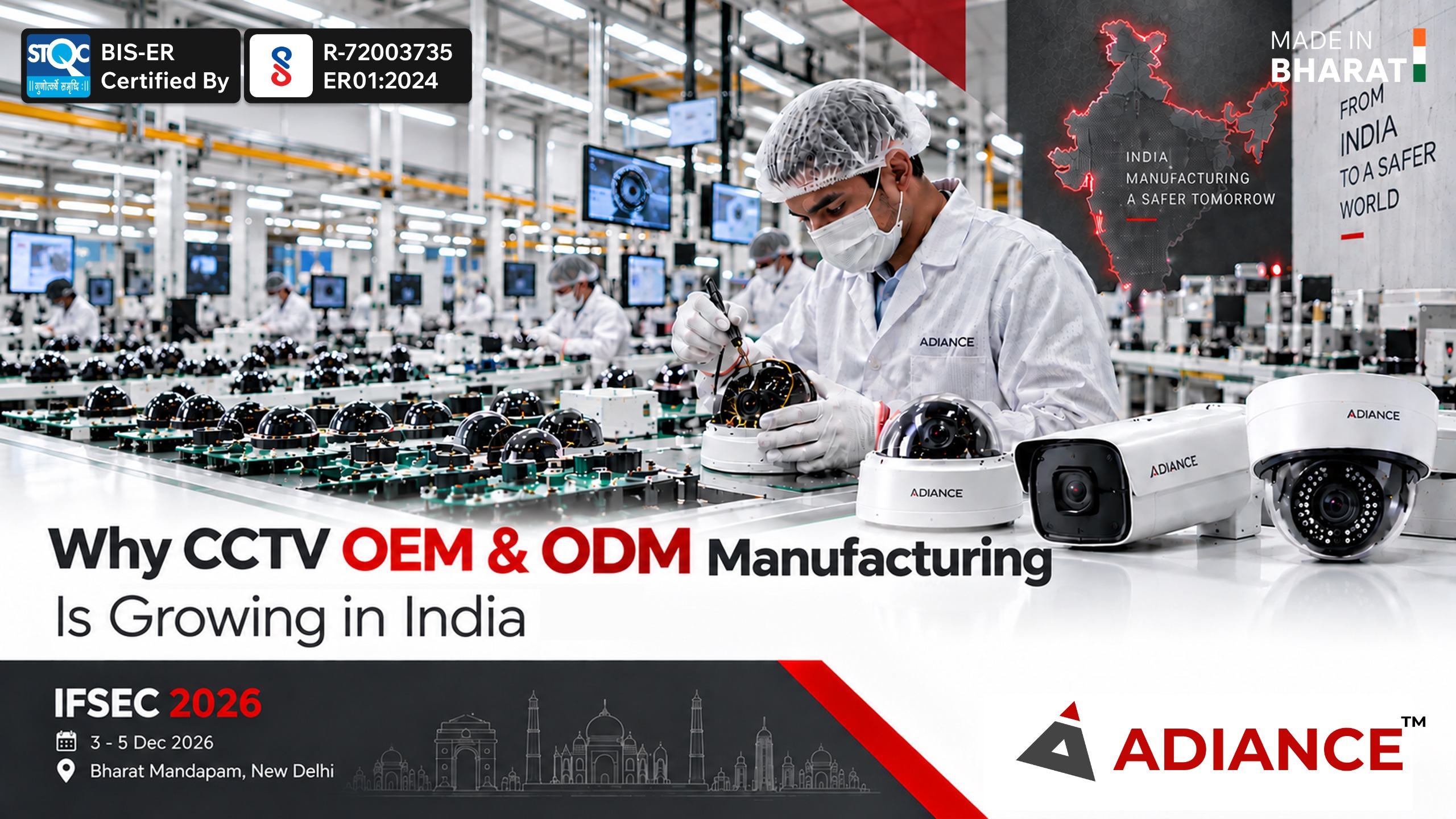
When the security industry gathers at IFSEC India 2026 in New Delhi this December, one shift will be impossible to miss on the show floor: a growing share of the cameras, recorders and AI platforms on display are no longer imported and rebadged they are designed and built in India. The question buyers used to skip, "where is this actually made?", has become the first one they ask. CCTV OEM and ODM manufacturing is growing in India because three forces have converged at once: a mandatory cybersecurity certification regime (BIS-ER and STQC), Make-in-India procurement rules that reward domestic production, and a global move away from Chinese surveillance supply chains. Together, they are pushing brands to build with Indian manufacturers that own their production, firmware, and compliance rather than importing commodity hardware they cannot certify. This piece explains what is driving that shift, what the numbers say, and what IFSEC India 2026 will reveal about where it goes next.
What CCTV OEM and ODM Manufacturing Actually Means
Before the drivers, the definitions — because buyers use these terms loosely and the difference decides how a brand is built.
OEM and ODMare the two ways a brand sells cameras it did not build itself. OEM (Original Equipment Manufacturer) means the manufacturer builds to your specification — you bring the requirements, the factory produces it under your brand. ODM (Original Design Manufacturer) means the manufacturer already owns the design, and you apply your branding and firmware skin to a proven product. OEM gives a brand more control and differentiation; ODM gives it faster time to market and lower up-front cost.
What is growing in India is the full ecosystem behind both models: surface-mount (SMT) production lines, in-house firmware and AI teams, and the compliance infrastructure that lets a domestically built camera clear India's certification bar. That combination — not just final assembly — is what turns a country into a manufacturing hub rather than a screwdriver shop.
The Numbers Behind the Shift
The growth is not anecdotal; it tracks a large and fast-expanding market.
India's video surveillance market is projected to grow from roughly USD 4.8 billion in 2025 to around USD 14 billion by the early 2030s, a compound annual growth rate close to 20%, according to market research from Mordor Intelligence. That demand is driven by the Smart Cities Mission, mandatory public-safety deployments, and enterprise expansion across BFSI, retail, logistics and critical infrastructure. Crucially, a rising share of that spend now carries a domestic-manufacturing and compliance condition attached which is exactly the demand imported commodity hardware can no longer legally serve.
When a market this large adds a "must be built and certified in India" requirement, the manufacturing base has no choice but to grow to meet it.
Why OEM and ODM Manufacturing Is Growing in India: The Real Drivers
Five structural forces are moving the manufacturing center of gravity to India. They reinforce each other, which is why the shift is accelerating rather than drifting.
1. The compliance reset. This is the single biggest accelerant. CCTV cameras sold in India now fall under a mandatory, cybersecurity-focused certification regime, and from 1 April 2026 only cameras that meet the notified Essential Requirements and hold valid BIS-ERand STQCcertification can be legally manufactured, imported or sold. A large share of the imported hardware that dominated Indian shelves is effectively locked out, and manufacturers with certified, domestically built lines inherit the gap.
2. Make-in-India and procurement preference. Government, BFSI and critical-infrastructure tenders increasingly require Made-in-India manufacturing, and public-procurement rules reward domestic value addition. Incentive schemes for electronics manufacturing further improve the economics of building — not just assembling — in India. For a brand chasing institutional contracts, a domestic OEM/ODM partner is no longer optional.
3. Non-Chinese, trusted supply chains. Procurement bans and data-security scrutiny across the US, Europe and India have made country of origin a commercial issue, not a checkbox. Indian manufacturers building around non-Chinese silicon are positioned for exactly the "China+1" sourcing that Western buyers and Indian tenders now demand — which is a major reason global brands are shifting production toward Indian OEMs.
4. A real electronics manufacturing base. India now hosts SMT lines, design houses and a skilled technical workforce capable of producing cameras to global standards with in-house quality control and traceability — genuine production, not final assembly. That capacity is what lets domestic supply absorb the demand imports can no longer legally serve.
5. Cost without the compliance compromise. India delivers competitive unit economics while clearing the regulatory and trust bars that the cheapest imports cannot. Affordable and compliant is a rare combination, and it is the heart of the opportunity — for domestic brands and for export.
What IFSEC India 2026 Will Signal About the OEM/ODM Shift
Trade shows are where a market's direction becomes visible, and IFSEC India 2026 is the clearest window into this one.
Held from 3 to 5 December 2026 at Bharat Mandapam (Pragati Maidan) in New Delhi, IFSEC India is South Asia's largest commercial security expo and conference, organised by Informa Markets India, and its 19th edition is expected to draw 350+ exhibitors and 14,000+ professionals across CCTV, video surveillance, VMS, access control, AI and cybersecurity. Three things are worth watching for as a read on the OEM/ODM shift: how many exhibitors lead with BIS-ER and STQC certification rather than raw specs; how many foreground Made-in-India manufacturing and non-Chinese supply chains; and how much of the AI and VMS software on show is built in-country rather than licensed. The direction of those three signals is the direction of Indian surveillance manufacturing.
What This Means for Brands and Buyers
For a surveillance brand, the practical takeaway is simple: the manufacturing decision is now a compliance and market-access decision. Choosing a domestic OEM/ODM partner that holds its own certifications, owns its firmware and AI, and can produce tender-ready documentation is what determines which contracts you can even bid for. For buyers and integrators, the same logic runs in reverse — verifying that a camera is genuinely built and certified in India, with the paperwork to prove it, is now part of basic due diligence, not a nice-to-have.
The brands that align with a genuinely engineered-in-India partner now are positioned for every stage of this shift at once.
Build With Adiance
If CCTV manufacturing is moving to India, the partner you choose decides whether you ride the shift or watch it. Adiance was built in India to be exactly that partner — a full-stack OEM and ODM manufacturer of intelligent CCTV.
In-house manufacturing - our own surface-mount (SMT) lines with a capacity of roughly 12 lakh units per year (1.2 million units), so your volume scales domestically without a supply-chain middleman.
BIS-ER-certified, Made-in-India - BIS-ER, STQC, CE, FCC, RoHS, ONVIF, and ISO 9001, held in our own name, with tender-ready documentation and data sovereignty built in.
Owned firmware and AI - our ArcisAI ecosystem spans Eco Series and S Series cameras, NVRs, an STQC-certified VMS, cloud, and an AI layer including ArcisGPT, ABD (AI-based detection) and ArcisBot, with patented bandwidth and storage optimization and vertical rule packs across energy, construction, retail, EV charging, BFSI, and industrial.
Track record - manufacturing in Ahmedabad since 2002, with clients including TATA, Reliance, Jio, ONGC, HDFC Bank, ICICI Bank, Western Railway and the Election Commission of India.
Related Reading
Why the Future of Surveillance Will Be Built in India
Why Global Security Brands Are Shifting to Indian OEM Manufacturers
Frequently Asked Questions
Why is CCTV OEM and ODM manufacturing growing in India?
Because three forces converged: a mandatory BIS-ER and STQC cybersecurity certification regime (with only compliant cameras sellable from 1 April 2026), Make-in-India procurement rules that reward domestic production, and a global shift away from Chinese surveillance supply chains. Together they push brands to build with certified Indian manufacturers.
What is the difference between OEM and ODM in CCTV manufacturing?
OEM means the manufacturer builds a camera to your specification, giving you more control and differentiation. ODM means you brand the manufacturer's existing, proven design, giving you faster time to market and lower up-front cost. Many brands start ODM and move selected products to OEM as they scale.
Do CCTV cameras have to be made in India to be sold there?
BIS-ER certification is mandatory to sell IP cameras in India, and from 1 April 2026 only cameras meeting the notified Essential Requirements can be sold. Government, BFSI and critical-infrastructure tenders additionally require Made-in-India manufacturing, which is why domestic OEM/ODM production is growing.
When and where is IFSEC India 2026?
IFSEC India 2026 takes place from 3 to 5 December 2026 at Bharat Mandapam (Pragati Maidan), New Delhi. It is South Asia's largest commercial security expo and conference, covering CCTV, video surveillance, VMS, access control, AI and cybersecurity.
Is Indian-made CCTV competitive for export?
Yes. Cameras built to India's compliance standards using non-Chinese silicon are well-positioned for Western markets scrutinizing surveillance supply chains, and India-made hardware can carry tariff and cost advantages there