Video Analytics in Security: Why Modern Surveillance Depends on It
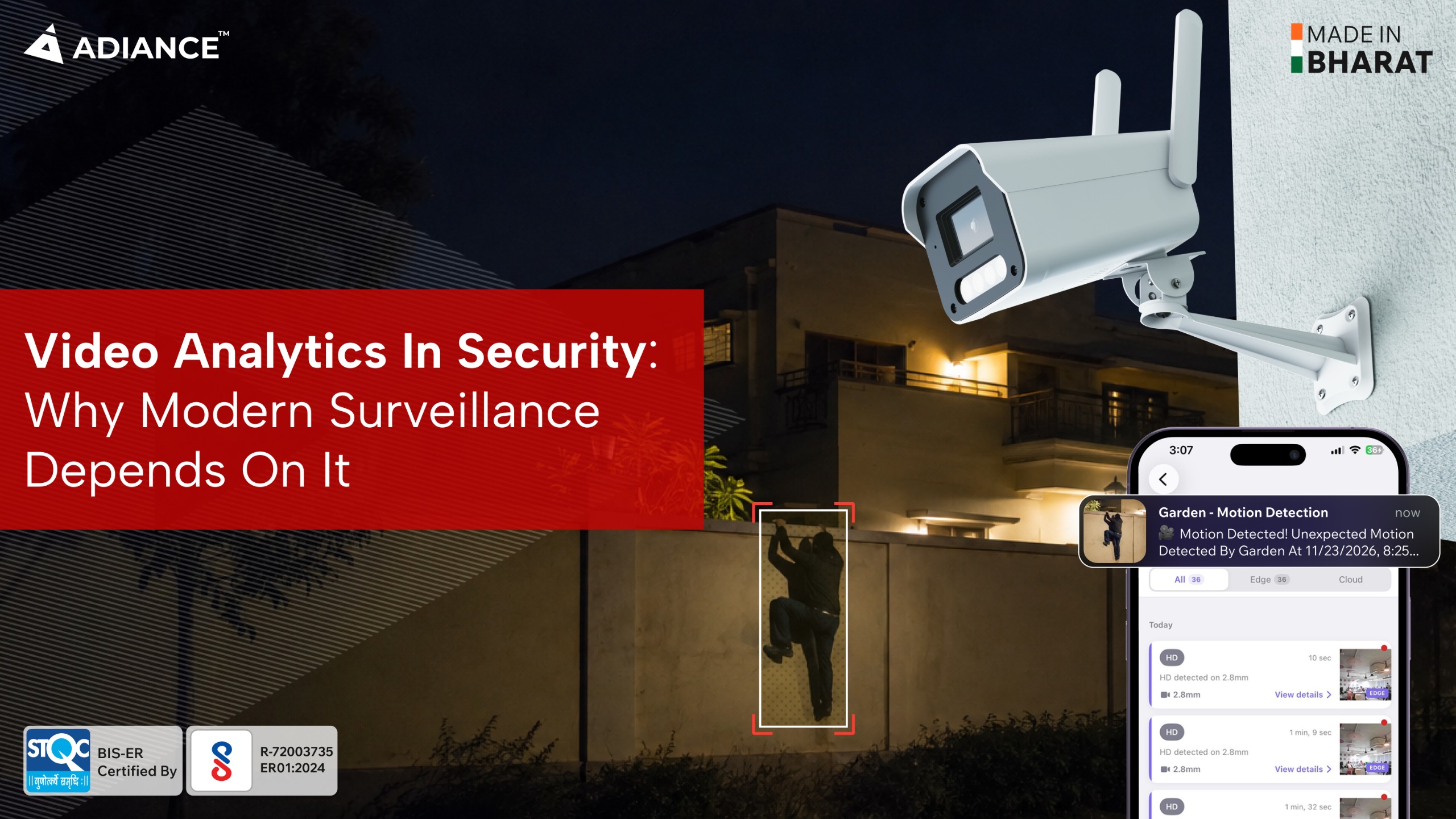
Most organisations do not have a camera problem. They have a footage problem. A mid-sized facility can run dozens of cameras that generate thousands of hours of recording every month, and almost none of it is ever watched. It is stored, it consumes bandwidth and disk space, and it sits idle until an incident forces someone to comb through it after the fact. By then the damage is done and the recording serves only as proof of what went wrong. This is the limitation that video analytics in security was built to solve. Instead of treating surveillance as a passive archive to review later, analytics turns the camera into a system that interprets what it sees and responds in the moment. For teams under pressure to do more without adding headcount, that shift has moved from luxury to operating standard. Here is what this guide covers:
What is video analytics in surveillance?
Video analytics, sometimes called intelligent video analytics or AI video surveillance, is software that automatically analyses video to detect, classify, and act on events without continuous human monitoring.
A conventional CCTV system captures and stores images, and the intelligence lives entirely with the operator reviewing them. Video analytics moves that intelligence into the system itself. It can tell that an object is a person rather than an animal, that a vehicle is travelling the wrong way, that someone has entered a restricted zone, or that a queue has grown past a safe limit, and it raises an alert the moment a defined condition is met.
The practical result is a move from reactive security, where footage is examined after an event, to proactive security, where the system surfaces a developing situation while there is still time to act.
Why video analytics is becoming essential now
Several trends have converged to push analytics from a high-end extra toward a baseline expectation:
- Data volume has outgrown human review. As camera counts and resolutions climb, footage is being produced faster than any team can watch it. Unwatched video offers little protective value.
- Human attention has limits. Studies of control-room performance consistently show operators miss a large share of significant events within a short period of continuous viewing. Analytics does not tire or lose focus across a long shift.
- The technology has matured. Better AI models and more capable processors mean reliable detection now runs on affordable hardware, not just expensive servers.
- Expectations have risen. Stakeholders want security to prevent incidents, not just document them, and to produce auditable evidence quickly. Compliance and data-protection pressures add further reason to process video intelligently rather than simply hoard it.
How modern video analytics works
The clearest way to understand video analytics in security is by where the processing happens, because that choice shapes speed, cost, reliability, and privacy.
On-device detection
At the most basic level, analytics runs inside the camera. Entry-level AI cameras handle core tasks such as separating people from background motion and detecting tampering when a lens is blocked or moved. The real value of this layer is that it cuts false alarms, and false alerts are the single biggest reason teams stop trusting their systems. Filtering out routine movement, shadows, and weather is foundational, not trivial.
Edge processing
Edge analytics runs heavier AI models on a dedicated camera or local appliance, close to where video is captured. The benefits compound:
- Real-time decisions, made on-site in milliseconds
- Resilience, since detection keeps working even if the internet drops
- Lower bandwidth and storage cost, because the system sends alerts and clips instead of streaming raw video
- Data stays local, which supports privacy and compliance
- For manufacturing sites, warehouses, and remote locations with patchy connectivity, edge processing is usually the most dependable approach.
Cloud analytics and storage
The cloud complements on-device and edge processing in two ways:
- It protects evidence. A single on-site recorder is one point of failure. Footage synced off-site survives even if the local device is stolen or destroyed, and it enables unified oversight across many sites.
- It scales advanced analytics on demand. Once events and footage are centralised, capabilities such as facial recognition, license-plate reading, people counting, heat-mapping, cross-site forensic search, and industry-specific behaviour detection can be applied without replacing hardware.
In strong deployments these layers are not rivals. On-device, edge, and cloud work together, each handling the part of the job it does best.
Where video analytics delivers the most value
The return on analytics is clearest when you look at specific industries:
- Retail: footfall counting, shopper movement and heat-mapping, queue management, and theft deterrence from the same cameras
- Manufacturing and industrial: safety enforcement such as detecting people in hazardous zones or missing protective gear, plus perimeter intrusion detection
- Banking and financial services: access control, ATM and cash-area monitoring, and auditable event logs for compliance
- Energy and utilities: securing remote, unmanned infrastructure where patrols are impractical
- The pattern is consistent across all of them: analytics converts passive surveillance into a tool that both protects assets and informs daily operations.
Benefits beyond catching intruders
It is easy to frame video analytics purely as threat detection, but its value reaches further:
- Faster response, by alerting operators while an event unfolds rather than after
- Lower monitoring cost, by cutting the manual hours needed to keep watch
- Stronger accountability, by making footage searchable and evidence easy to retrieve
- Business intelligence, with the same feeds yielding data on customer behaviour, space use, and process efficiency
For many organisations, those operational insights help justify the investment well beyond the security budget alone.
What to look for before you invest
Choosing an analytics-capable system is as much about the future as the present. A few priorities matter more than long feature lists:
- Accuracy. A system that floods operators with false positives gets ignored, no matter how advanced it claims to be.
- Scalability. You should be able to add advanced capabilities later without ripping out the cameras you install today.
- Integration. Analytics must connect cleanly with your access control, alarms, and existing infrastructure, or it creates more work than it removes.
- Data security and compliance. Non-negotiable wherever footage is sensitive or regulated.
- Hardware reliability. Real-time analytics is only as good as the camera and processor running it.
There is one priority buyers often discover too late. These capabilities frequently arrive from different suppliers, with cameras from one source, edge devices from another, storage from a third, and analytics bolted on by a fourth. Every seam between them becomes a point of failure and a support headache. Sourcing the full capability from a single manufacturer that designs these layers to work together removes that fragmentation and gives you one accountable partner instead of several.
Build your video analytics on a foundation that scales
Higher resolution tells you what happened. Video analytics in security tells you something is wrong while you can still act on it. That difference is why analytics is shifting from an optional upgrade to a core requirement for modern surveillance.
The hard part for most buyers is getting every layer from one source that can match the global leaders on capability. That is exactly where Adiance fits. We build the full stack as one connected ecosystem:
- Eco Series cameras with on-board human, motion, and tamper detection
- A dedicated S Series carrying eight built-in edge AI models for real-time, on-site decisions
- The Cloud Solutions, adding cloud storage and advanced cloud analytics, so you can expand capability without replacing hardware
As a full-stack OEM and ODM manufacturer based in Ahmedabad, India, with in-house SMT production, we deliver every layer ready for you to brand and scale as your own, matching the global names on capability while keeping the platform genuinely yours.
Frequently Asked Questions
What is video analytics in security?
It is AI-powered software that automatically analyses video to detect and classify events such as people, vehicles, intrusions, or unusual behaviour, and alerts operators in real time rather than leaving footage to be reviewed manually after an incident.
What is the difference between edge and cloud video analytics?
Edge analytics processes video on the camera or a local device for instant, offline-capable decisions and lower bandwidth use. Cloud analytics processes data centrally, which suits advanced, scalable tasks like cross-site forensic search. Most effective systems combine both.
Can analytics be added to an existing camera system?
Often, yes, especially if footage and events can sync to a cloud platform that supports added analytics. The key is choosing an ecosystem designed for that upgrade path from the start.
Is video analytics only useful for security?
No. The same technology routinely supports operational goals such as footfall counting, queue management, space utilisation, and safety compliance, which is why many deployments are justified on business value as well as security.