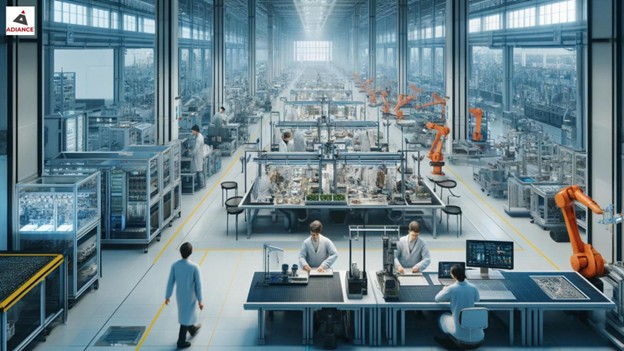
India, the world's second most populous nation, is experiencing a thrilling economic boom. This rapid growth is transforming the country into a major force on the international scene. Fueling this rise is a powerful wave of technological innovation. India's economy is increasingly driven by cutting-edge advancements, attracting collaboration with even the most developed nations. As the world embraces a knowledge-based society, India is not just keeping up, it's thriving. By leveraging advancements in information and communication technology (ICT), India is solidifying its position as a key player in the global economic landscape.
The increasing number of internet users and the rapid development of ICT have played crucial roles in this transformation. One of the standout sectors in India's economy is electronics manufacturing, which is witnessing a significant boom. This growth spans various segments, including automation, defence, and consumer electronics.
Government initiatives like Digital India and Make in India have been the secret weapon behind India's electronics industry boom. Digital India focuses on building a strong digital backbone for the country. This means making sure everyone has access to high-speed internet, which is crucial for companies to operate efficiently.
Make in India, on the other hand, is all about encouraging companies to set up shop and manufacture their products within India. This not only creates jobs but also reduces reliance on imports, making the industry more self-sufficient. Together, these programs create a win-win situation for both the government and the electronics industry. Companies benefit from a supportive environment with good infrastructure, while the government attracts investments and fosters innovation within the country.
India's ambitions in the electronics sector stretch far beyond simply fulfilling its own needs. The country is setting its sights on becoming a dominant force in the global market. This rise is fueled by advancements in key areas like automation, defence technology, and consumer electronics. These impressive strides showcase India's ability to compete with the world's best. By continuing to invest in these areas and fostering innovation, India can ensure its growth trajectory remains steady, solidifying its position as a major player in the global economy.
Drivers of Long-Term Growth and Innovation
Localization is King
A major trend transforming the electronics manufacturing industry (EMS) is the rise of localization. This means big brands (Original Equipment Manufacturers or OEMs) are increasingly choosing to manufacture their products closer to where they'll be sold. This shift is driven by a desire to cut costs and improve efficiency.
Here's where India comes in Indian EMS companies are in a prime position to benefit from this trend. By offering custom-made solutions that cater to the specific needs of Indian production, they can become key players in the domestic electronics market. Understanding the unique aspects of the Indian market and building strong partnerships with OEMs will be crucial for their success.
Tech Revolution
The world of electronics manufacturing is undergoing a radical transformation fueled by a surge in cutting-edge technologies. Imagine factory floors where machines seamlessly talk to each other (thanks to the Internet of Things, or IoT) and intelligent systems constantly analyze and optimize production (powered by Artificial Intelligence, or AI). This isn't science fiction, it's the exciting reality for forward-thinking Electronic Manufacturing Services (EMS) providers. By embracing these advancements, EMS companies are unlocking a new level of efficiency and competitiveness. Production cycles become faster and smoother, while product quality reaches new heights. It's a win-win for both EMS providers and consumers alike.
Going Green
The Indian EMS industry isn't just focused on growth, it's also becoming increasingly eco-conscious. With environmental issues becoming a top priority, EMS providers are actively embracing sustainability. This translates to real action: using materials that can be recycled, implementing production processes that use less energy, and minimizing waste throughout the manufacturing cycle. By prioritizing a greener future, these companies aren't just doing their part for the environment, they're also making themselves more attractive to a growing number of environmentally conscious consumers and investors who are looking to support companies that share their values.
Digital Transformation
The digital revolution is fundamentally reshaping the way EMS companies operate. EMS providers can significantly improve their operations by leveraging digital technologies like data analytics and advanced supply chain management systems. Data analytics allows for real-time monitoring of production lines, identifying bottlenecks and optimizing processes for efficiency. Sophisticated supply chain management systems ensure timely delivery of components and finished products, minimizing disruptions and delays. This digitalization drive empowers the industry to become more adaptable and responsive to ever-changing market dynamics.
Government Backing
The Indian government isn't just sitting on the sidelines when it comes to the EMS industry's success. They're actively cheering it on! Initiatives like the Production Linked Incentive (PLI) scheme are like a high-five to companies that set up shop or expand their manufacturing in India. These programs offer sweet deals, like tax breaks or financial assistance, making it even more attractive for companies to invest in India. This strong government support gives EMS providers a major boost. They can easily scale up their operations, taking advantage of new opportunities in both the Indian and international markets.
Initiatives by Government
Make in India
In 2014, India launched "Make in India," a program designed to jumpstart the country's manufacturing sector. This initiative acts like a magnet for businesses, both domestic and international. It offers a sweetening package of benefits - financial incentives, tax breaks, and simplified regulations. This not only makes India a more attractive option for manufacturers but also translates to more jobs and a stronger domestic economy.
Production-Linked Incentive (PLI) Scheme
Capitalizing on the momentum of "Make in India," the government launched the Production-Linked Incentive (PLI) scheme. This ambitious program acts as a powerful growth engine for the electronics manufacturing sector. With a commitment of Rs 409.51 billion ($5.5 billion) spread over five years, the PLI scheme provides significant financial incentives to large-scale electronics manufacturers. This translates to a major economic boost, encouraging companies to set up new facilities or expand their existing ones in India. As a result, the PLI scheme acts as a catalyst, accelerating the overall growth of the electronics manufacturing industry.
Electronics Manufacturing Clusters (EMCs)
Capitalizing on the momentum of "Make in India," the government launched the Production-Linked Incentive (PLI) scheme. This ambitious program acts as a powerful growth engine for the electronics manufacturing sector. With a commitment of Rs 409.51 billion ($5.5 billion) spread over five years, the PLI scheme provides significant financial incentives to large-scale electronics manufacturers. This translates to a major economic boost, encouraging companies to set up new facilities or expand their existing ones in India. As a result, the PLI scheme acts as a catalyst, accelerating the overall growth of the electronics manufacturing industry.
National Policy on Electronics (NPE)
Imagine India as a giant electronics factory, churning out cutting-edge devices! That's the ambitious vision behind the National Policy on Electronics (NPE). This policy is like a detailed map, guiding India's journey towards becoming a $400 billion electronics powerhouse by 2025.
Here's what makes the NPE so exciting:
* Making More in India: The policy aims to increase "domestic value addition." Think of it like building a product yourself instead of just buying parts. The NPE wants more electronics manufacturing steps to happen within India, boosting the local economy.
* Jobs Galore: The plan is to create tons of new jobs in the electronics industry. This means more opportunities for people and a boost to India's overall economic growth and social development.
In simpler terms, the NPE is a recipe for India's success in the electronics world, focusing on both making more electronics at home and creating exciting new job opportunities.
A Look Ahead at the Electronics Industry
Semiconductor Chips
These are the workhorses of modern electronics. Imagine a miniature city built on a silicon wafer, where billions of microscopic transistors act like tiny switches and gates. These transistors control the flow of electricity, allowing the chip to perform calculations, store data, and process information. Semiconductor chips come in various types, each specialized for specific tasks. Microprocessors, for example, are the central processing units (CPUs) of computers, handling complex calculations and instructions. Memory chips store data, while graphics processing units (GPUs) accelerate tasks involving images and videos. The continued miniaturization and increasing complexity of these chips have fueled the rapid advancements in computing power and functionality we see today.
Quantum Computing
Imagine a computer that can be a 0 and a 1 at the same time. That's the weird and wonderful world of quantum computing! Unlike our regular computers that use bits (either 0 or 1), quantum computers use qubits. These qubits can exist in a state called superposition, meaning they can be both 0 and 1 simultaneously.
This might sound like science fiction, but it unlocks incredible processing power. Quantum computers can tackle problems that would take traditional computers years, even centuries, to solve. Imagine simulating complex molecules for drug discovery or optimizing financial models with mind-blowing accuracy. That's the potential of quantum computing!
However, it's not quite time to throw out your laptop just yet. Building and maintaining these superpowered machines is a big challenge. Think of it like training a superhero - it takes time and effort. While widespread practical applications might be a few years down the road, quantum computing is a technology to watch. It has the potential to revolutionize fields like medicine, finance, and materials science, and the future is looking bright!
Artificial Intelligence (AI)
AI is the field of computer science dedicated to creating intelligent machines that can mimic human cognitive functions. These machines can learn from data, identify patterns, and make decisions without explicit programming. AI encompasses a wide range of techniques, from machine learning algorithms that improve with experience to deep learning models inspired by the structure and function of the human brain. We interact with AI daily through virtual assistants like Siri or Alexa, recommendation systems on streaming platforms, and spam filters in our emails. We can expect even more sophisticated applications as AI evolves, potentially transforming industries like healthcare, finance, and transportation.
6G Network
The current 5G network has ushered in an era of ultra-fast mobile data, but 6G promises to be a game-changer. With speeds potentially exceeding one terabit per second (Tbps), 6G will enable near-instantaneous data transfer. Imagine downloading a full-length movie in a fraction of a second or experiencing virtual reality with no lag or delay. This high bandwidth will also support the development of the Internet of Things (IoT) on a massive scale. Billions of connected devices, from smart appliances to self-driving cars, will communicate seamlessly with minimal latency. However, the development of the 6G infrastructure is still in its early phases, with technical challenges and standardisation issues needing to be addressed before widespread adoption.
Conclusion
India's future in electronics manufacturing is shining bright. Several factors are converging to create a perfect storm for growth. First, a young and tech-savvy population with rising disposable incomes is fueling a massive domestic demand for electronics. This translates to a hungry market eager for locally produced gadgets and devices.
Second, the Indian government is actively rolling out the red carpet for the industry. From offering financial incentives like tax breaks and subsidies to streamlining regulations and building dedicated manufacturing zones, the government is creating a supportive and business-friendly environment. This makes India a highly attractive destination for electronics companies looking to set up shop or expand their existing operations.
Finally, India has a skilled workforce ready to meet the diverse needs of the electronics industry. This, coupled with the ongoing shift in global supply chains seeking to diversify production locations, positions India perfectly to become a global manufacturing hub for electronic products.
In a nutshell, India has the recipe for success: a booming domestic market, strong government backing, and a skilled workforce. By capitalizing on these strengths, India is poised to not just become a significant player, but a major force in the global electronics manufacturing landscape.
Industry References
For more information on the topics discussed in this article, visit these authoritative sources: Make in India Initiative (https://www.makeinindia.com/) | India Semiconductor Mission (https://www.meity.gov.in/)