Robotic Arms: Transforming the Landscape of Automation
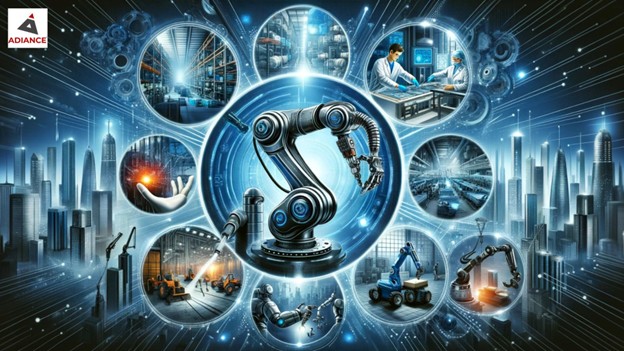
Industrial robotic arms are among the most widely used types of robots in use today, found in industries such as manufacturing, automotive, and agricultural. Articulated robotic arms, another name for robotic arms, are precise, dependable, and quick. They may be programmed to perform a limitless number of jobs in a wide range of settings. They are used in warehouses to pick, choose, or sort goods from distribution conveyors to meet customer orders; in farms to pick and arrange ripe crops into storage trays; and in factories to automate the execution of repetitive activities, such as painting equipment or parts. Furthermore, the capabilities of robotic arms grow to enable new use cases and business operating models as robotic technologies advance and industrial environments become increasingly networked. Previously, a robotic arm needed to be trained to accomplish certain functions, such as selecting a particular kind of product from a precise spot with a particular orientation. Robots were unable to distinguish one type of object from another among a variety, locate objects with a tolerance of area rather than precise position, or modify their grasp in response to an object's orientation. Robotic arms can now perceive, interpret, and react to their surroundings while sending useful information and insights back to facility and business management systems thanks to developments in machine vision, artificial intelligence, and networking technology. One sector that gains from this change is the maintenance of equipment, including robots. For remote monitoring, the robot can process data locally or send it to a server or the cloud. Predictive maintenance is made possible by this procedure, which lowers maintenance expenses while increasing equipment uptime.
Advantages of Using Industrial Robotic Arms
Enhanced Security
Robotic arms serve as indispensable guardians of worker safety, bravely navigating hazardous environments and tackling tasks fraught with potential risks of injury. Their presence is a shield against harm, allowing humans to remain out of harm's way while their robotic counterparts venture into perilous territories. Whether it's the searing heat of a foundry, the toxic fumes of a chemical plant, or the unpredictable machinery of a manufacturing facility, robotic arms fearlessly step in to shoulder the burden of dangerous tasks. By shouldering these responsibilities, they not only mitigate the risk of harm to human workers but also uphold productivity and efficiency in workplaces where safety is paramount.
Enhanced Efficiency and Output
Robotic arms, which can work nonstop for 24 hours a day, seven days a week, are the hidden heroes of industrial efficiency. Businesses benefit greatly from this unwavering workhorse quality, which allows them to continue with manufacturing, inspections, and other crucial duties. Businesses can greatly increase their output by removing downtime caused by human fatigue or the need for breaks when robotic arms are in charge. These devices provide reliable performance at all times, whether they are managing complex tasks, operating on the factory floor, or participating in quality control procedures. Their unwavering work ethic benefits companies in a variety of industries by increasing production, streamlining processes, and eventually increasing profitability.
Improved Accuracy
Because robotic arms are designed to be precise and consistent, they are better than human hands at tasks that call for accuracy or consistency. These devices guarantee perfect performance, particularly in settings where even minor mistakes can have a big impact. Robotic arms excel in situations requiring accuracy, whether they are assembling complex parts or completing monotonous jobs with unshakable regularity. In contrast to humans, whose performance might fluctuate or degrade, these robots consistently operate at maximum accuracy, guaranteeing dependable outcomes even over extended periods. This dependability ushers in a new era of efficiency and quality assurance in automated operations, particularly in industries where accuracy is crucial.
Increased Adaptability
The versatility of robotic arms is evident when corporate needs change. These adaptable devices provide unmatched versatility by adjusting to new jobs or situations with ease. Robotic arms can be used to mount objects on walls or shelves for space optimisation, integrate them into autonomous mobile robots (AMRs) for dynamic workflows, or place them on stationary assembly line platforms for precision manufacturing. Their adaptability to many platforms and modular structure renders them highly important resources in the current dynamic corporate environment. Businesses can quickly adapt to new needs using robotic arms, assuring maximum productivity and efficiency across a range of processes.
Exploring the Versatility of Robotics in Various Fields
The ability of industrial robotic arms to handle a wide range of applications, from the easiest to the most difficult tasks in the safest or harshest conditions, is one of its main advantages. By automating these kinds of jobs, human workers can be freed up to handle high-value duties like interacting with clients instead of being placed in potentially dangerous situations.
The following are the most commonly used areas of Robotic Arms:
Production and Robotics
Manufacturing is leading the way in adopting robots; automated assembly lines and robotic arms are generating significant gains in productivity, quality assurance, and efficiency. Advances in machine learning and computer vision have allowed robots to move beyond their fixed functions and become dynamic machines that can adapt to changing production needs. This versatility leads to increased productivity as well as cost savings because automation can handle a wide range of jobs and situations with ease. Manufacturers benefit from increased flexibility and responsiveness in their operations, which helps them maintain high standards of quality and productivity in the face of changing market conditions.
Health Services and Recovery Support
In the healthcare industry, robots are now considered crucial, providing medical workers with essential assistance with a variety of duties. One notable feature of surgical robots is their capacity to enable minimally invasive treatments, which greatly minimises patient stress and recovery time. These cutting-edge tools give surgeons more control and precision, which improves patient outcomes. Furthermore, after operations or injuries, robotic exoskeletons have proven to be useful instruments in physical therapy and rehabilitation, helping patients regain their independence and movement. By utilising robotics in healthcare, we're raising the bar for medical technology while simultaneously enhancing patient care.
Agriculture and Farming
Robotic automation of labour-intensive processes such as planting, harvesting, and crop monitoring is causing a revolutionary change in the agricultural sector. These robots are changing agricultural methods by combining data analytics and artificial intelligence (AI). They can improve total agricultural output, identify illnesses early, and optimise resource utilisation by utilising AI algorithms and data-driven insights. Agriculture is made more efficient and more sustainable by this smooth integration of technology. Farmers can increase output, lessen their reliance on physical labour, and ensure more accurate and effective crop management with the help of robots, which will usher in a new era of sustainable and productive farming techniques.
Space Discovery and Investigation
Space exploration has been transformed by robots, which act as invaluable emissaries in far-off and frequently dangerous regions. NASA's robotic rovers, like as Curiosity and Perseverance, which have explored the untamed surface of Mars, are among the most well-known. With the help of a variety of scientific instruments, these advanced machines can examine the Martian terrain, investigate its geology, and determine whether or not it is a suitable place for future human exploration and settlement. These robotic explorers have worked tirelessly to bring humanity hitherto unheard-of insights into the mysteries of our neighbouring planet, opening the door for manned trips in the future and broadening our understanding of the universe overall.
Advancements in Automated Systems: A Journey Through Technological Evolution
Automation technology has advanced tremendously over the years, going from simple analogue circuits and relays to the complex digital controllers of today. These sophisticated systems of today enable programmers to design robots that can perform difficult jobs with previously unheard-of accuracy and precision.
Developments in machine vision technologies are essential to this leap forward in technology. Thanks to these advancements, robots can now see and understand their environment, which gives them the capacity to recognise items and decide how best to interact with them. Robotic systems are now capable of navigating challenging settings with confidence and adaptability thanks to this enhanced visual acuity.
With the introduction of artificial intelligence (AI), robotics is entering a new era. Robots are now able to learn from their experiences and improve their decision-making and task performance over time by utilising AI algorithms. In addition to increasing production, this adaptive intelligence gives robots the flexibility to overcome unforeseen difficulties and barriers without the need for explicit programming.
Automation technology has reached previously unexplored levels of efficiency and adaptability thanks to the confluence of digital control, machine vision, and artificial intelligence. Robotic automation has limitless applications in a variety of industries and can spur innovation in ways that were not before possible. Its revolutionary power has the potential to upend entire industries and bring in a new period of development and prosperity.
Conclusion
Robotics technology represents a turning point in human evolution, bringing in a new era in which machines become intelligent collaborators in our pursuit of progress. Robots are transforming industries and changing our social environment in a variety of contexts, including production floors, hospitals, farms, and far-off galaxies. Embracing robots' limitless potential means striking a careful balance while negotiating complexities and moral quandaries to create a future in which people and machines coexist together. By encouraging cooperation and understanding between people, we open the door to a future in which people and machines live in harmony, creating a wealth of previously unimaginable prospects and ringing in a new era of advancement.
Industry Resources
For more information on the topics discussed in this article, visit these authoritative sources: International Federation of Robotics (https://ifr.org/) | IEEE Robotics & Automation Society (https://www.ieee-ras.org/)