OEM vs ODM: Which One is Best for Your CCTV Brand?
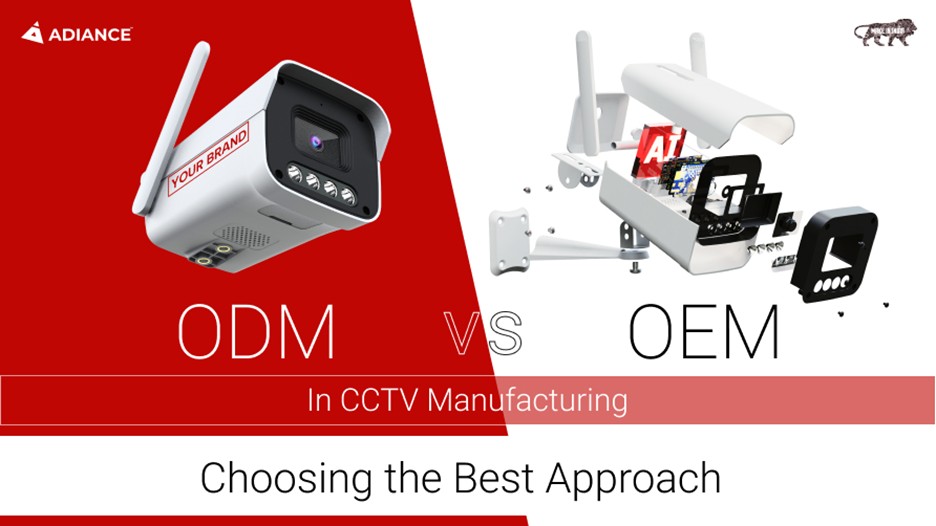
The CCTV industry in India is on a steep upward trajectory. According to Mordor Intelligence, the India Video Surveillance Market is projected to soar from USD 4.40 billion in 2025 to USD 7.12 billion by 2030, growing at a 10.1% CAGR. Other sources are even more optimistic: Grand View Research estimates growth from USD 2.03 billion in 2024 to USD 5.26 billion by 2030, at a robust 17.2% CAGR. This growth is driven by India’s expanding Smart City initiatives, booming retail sectors, and escalating security requirements. In this rapidly evolving landscape, brands face a pivotal decision: partner with an Original Equipment Manufacturer (OEM) or an Original Design Manufacturer (ODM). In this blog, we'll break down the OEM vs ODM CCTV debate - highlighting the strengths and trade-offs of each model, helping you determine the best fit for your brand’s goals.
Overview About ODM CCTV
ODM CCTV goes a step further by not only manufacturing but also designing the product. In this model, the manufacturer provides ready-made CCTV designs that can be rebranded and customized at the branding, firmware, or software level rather than in the hardware itself.
It is ideal for businesses that want faster market entry without investing in in-house design and R&D.
With ODM CCTV camera solutions, brands can quickly launch products, save on design costs, and leverage proven technology.
The trade-off: less control over core design and intellectual property, unless negotiated separately.
Overview About OEM CCTV
OEM CCTV refers to products manufactured strictly according to a brand’s own design, specifications, and intellectual property. In this model, the brand provides the complete design, while the OEM focuses solely on production.
It is best for businesses that already have R&D capabilities and want to maintain full control over product design, features, and IP ownership.
An OEM CCTV partnership ensures stable production, consistent quality, and compliance with the brand’s technical standards.
The limitation: requires strong design expertise from the client and may involve longer time-to-market.
OEM vs ODM – A Direct Comparison for CCTV Brands
Understand the key differences between OEM and ODM models in the CCTV industry — from product ownership and customization to branding and manufacturing control — to help your business choose the right path for growth.
Innovation Readiness
- OEM CCTV allows full innovation and customization, since the brand owns the design and can create unique hardware, firmware, and features from the ground up.
- ODM CCTV provides pre-designed solutions where innovation is limited mostly to software, firmware, and branding—not in the core hardware design.
Product Customization
- OEM allows full customization across hardware, firmware, and features since the brand owns the entire design and IP.
- ODM offers limited customization, mainly in branding, firmware, and software—not in the core hardware design.
Brand Identity
- OEM CCTV builds a strong and exclusive brand identity, since products are based on the company’s own intellectual property and cannot be duplicated by others.
- ODM CCTV helps brands enter markets quickly and establish presence, using proven product designs while adding uniqueness through software, AI features, and branding.
Cost Differences
- OEM requires higher upfront investment in R&D and design, but reduces long-term costs and gives higher control over margins.
- ODM lowers R&D expenses significantly and reduces entry barriers, though per-unit costs may be higher for specialized features.
Time-to-Market
- OEM may take longer because designs and prototypes need to be completed before manufacturing.
- ODM offers faster launches with ready-to-produce designs, allowing brands to enter markets quickly.
Scalability
- OEM is ideal for scaling unique and proprietary product lines while keeping full ownership.
- ODM is effective for scaling across multiple markets and industries, leveraging standardized platforms.
Quality Control
- OEM allows the brand to set and enforce its own quality standards throughout production.
- ODM ensures consistent quality through manufacturer standards, with options to negotiate stricter QC measures if needed.
Compliance
- OEM CCTV brand designs the product while making sure it meets certifications like BIS, FCC, or ISO. Since the brand owns the design, certifications are planned from the start and built into the product before manufacturing.
- The ODM CCTV manufacturer already has pre-certified products. This means the brand can launch faster, as most compliance approvals are already taken care of.
After-Sales Service
- OEM usually provides brand-managed after-sales service and support in line with its own standards.
- ODM often includes manufacturer-driven updates and support, especially for firmware, AI software, and feature enhancements.
Why Partner with Adiance for OEM and ODM CCTV Solutions
At Adiance Technologies, we empower brands to grow using both OEM and ODM CCTV services - helping you choose the model that aligns with your needs.
- End-to-End Manufacturing – From PCB to complete CCTV systems, we handle every stage of production.
- Compliance-Ready Systems – Our cameras meet BIS, FCC, STQC, ISO 27001 and CMMI standards.
- Flexible Partnerships – Choose ODM for faster market entry or OEM for full customization and unique AI-powered CCTV solutions.
- Innovation Focus – With ODM & OEM AI-powered CCTV solutions, we integrate EdgeAI, CloudAI, VMS, Advanced analytics, realtime reports and more.
- Scalable Support – Whether you’re a startup or an established enterprise, we ensure reliable supply chains and after-sales service.
With Adiance, you don’t have to pick sides in the OEM vs ODM debate - you can leverage both models for different stages of your brand journey.
Conclusion
When comparing OEM vs ODM CCTV, the right choice depends on your business strategy and long-term goals. OEM CCTV empowers brands with full innovation, hardware customization, and complete control over design and intellectual property, making it the ideal model for companies with in-house R&D and a vision for unique, differentiated products.
ODM CCTV, on the other hand, accelerates market entry with ready-made, proven designs that can be customized at the branding, firmware, and software level, allowing businesses to launch quickly and save on R&D investment.
At Adiance Technologies, we support both OEM and ODM models to serve diverse brand needs. Whether you want to build exclusive, fully customized AI-powered CCTV solutions through OEM or achieve rapid growth with ODM’s ready-to-market designs, we provide the right mix of manufacturing expertise, compliance, quality assurance, and innovation. This ensures your brand can thrive in India’s fast-growing and competitive CCTV market.
Industry Resources
For more information on the topics discussed in this article, visit these authoritative sources: ISO 9001 Quality Management (https://www.iso.org/iso-9001-quality-management.html) | Make in India Initiative (https://www.makeinindia.com/)
FAQs
Why are Indian and global CCTV markets growing rapidly?
Security demand is rising everywhere. In India, Smart Cities and retail expansion drive growth, while globally, BFSI and healthcare lead adoption. Our OEM and ODM CCTV solutions meet this growing need.
How does ODM help startups create unique CCTV products?
ODM gives startups access to manufacturer-designed CCTV systems that can be customized and rebranded. This saves significant R&D effort while still enabling features like AI integration, cloud storage, and advanced analytics. With Adiance ODM solutions, startups can quickly launch differentiated products and compete effectively.
Can Adiance Technologies provide both OEM and ODM services?
Yes. We specialize in both models. Our OEM services in India are ideal for brands with proprietary designs, while our ODM offerings help businesses launch rapidly with predesigned, customizable CCTV solutions. This flexibility ensures that every client—from startups to established brands—has the right pathway to growth.