The Growing Demand for Non-Chinese Surveillance Solutions
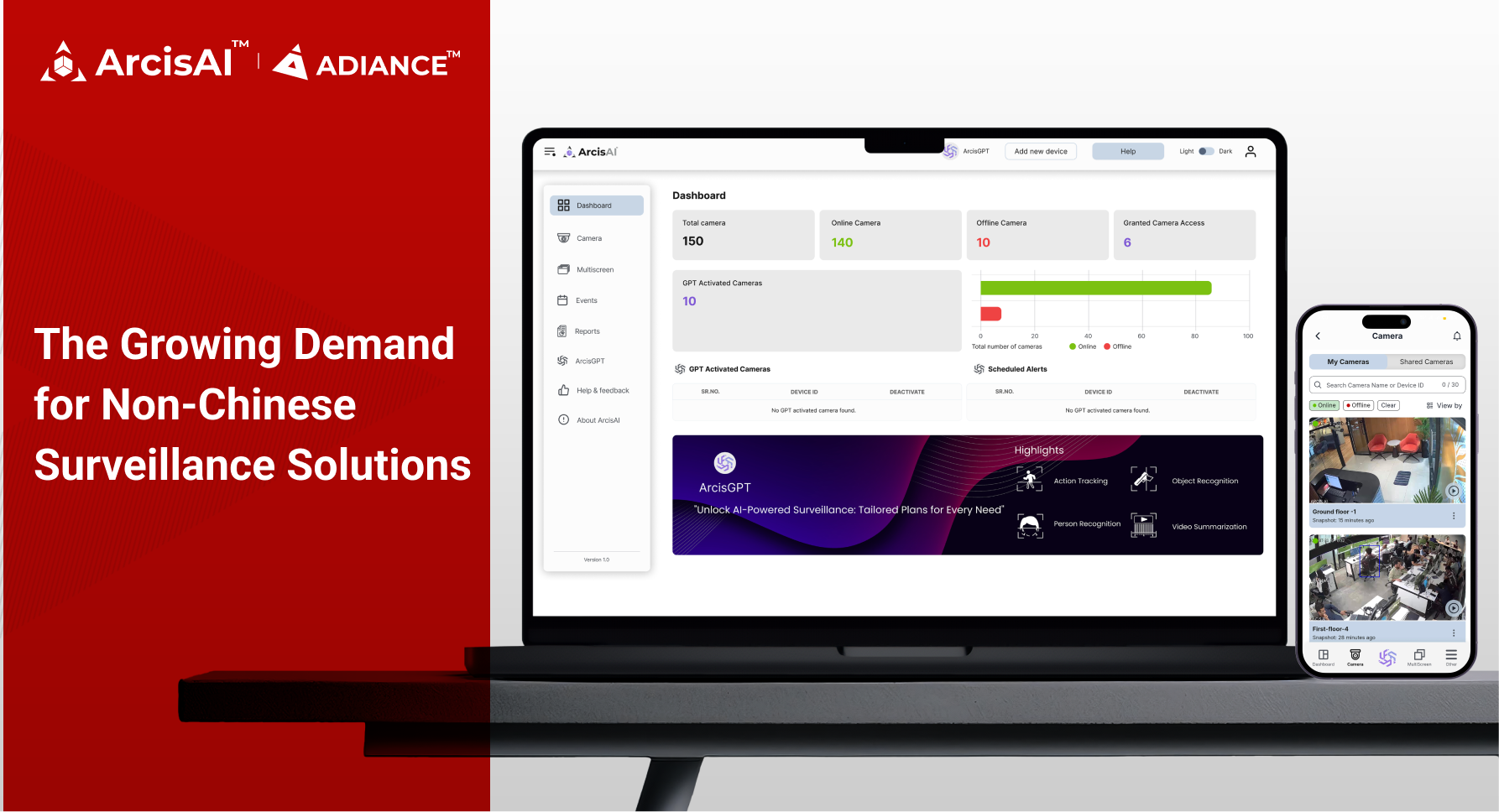
On April 1, 2026, the rules for buying a security camera in India changed for good. From that date, every internet-connected CCTV camera sold in the country must carry STQC certification under the Ministry of Electronics and Information Technology — and the government has been refusing to certify products built on Chinese-origin chipsets or firmware. The practical effect is blunt: cameras that dominated Indian shelves for a decade can no longer be legally sold or installed. The buyers who got hurt were the ones still treating "non-Chinese" as a nice-to-have. The ones who came out ahead had already moved. By February 2026 — before the deadline even arrived — domestic and non-Chinese brands had taken more than 80% of the Indian CCTV market. This isn't an India story. It's a global one, and it has been building for years. The question for any brand, integrator, or facility owner sourcing cameras today is no longer whether to consider non-Chinese surveillance. It's how much risk is sitting in the equipment they've already bought.
The regulatory dominoes have already fallen
What looked sudden was actually a slow accumulation. In the United States, NDAA Section 889 began phasing in restrictions on federal agencies and contractors in 2019–2020. The Secure Equipment Act of 2021 followed, directing the FCC to stop authorizing equipment deemed a national security risk. By late 2022, the FCC had blocked new authorizations for the named manufacturers — Hikvision, Dahua, Huawei, ZTE, and Hytera — under its Covered List.
The walls have kept closing. In October 2025, the FCC pushed major U.S. online retailers to pull millions of listings for unauthorized or restricted Chinese electronics, then moved to tighten the rules covering previously approved models. One detail matters for buyers who think a Western logo protects them: brands owned by restricted manufacturers are caught too — Lorex, for example, is owned by Dahua.
Other markets have moved in parallel. The UK government ordered sensitive sites to stop deploying equipment from companies subject to China's National Intelligence Law, and by April 2024, reported that roughly half of those sites had already been stripped of the gear. Lithuania banned Chinese-made surveillance across hundreds of public bodies. A string of U.S. states — Nebraska, Nevada, New Jersey, and New Hampshire — issued their own prohibitions for state networks.
Stack those together, and a pattern emerges that no single headline captures: across the US, UK, EU, and now India, the same equipment is being designed out of regulated procurement at roughly the same time.
Why buyers are actually making the switch
It would be easy to file this under geopolitics and move on. But the procurement managers driving the shift aren't reacting to politics — they're managing three concrete risks.
Cybersecurity is the headline concern. An internet-connected camera is a sensor that talks to a network all day. India's regulators pointed to exactly this when reports surfaced that footage from some Indian railway station cameras was being accessed from outside the country. STQC certification was built to check the things that actually fail in the field: secure boot, signed firmware, encrypted communication, access control, and where data is stored. The fear isn't abstract — it's a camera quietly routing footage somewhere it shouldn't.
Compliance is the gate, not the bonus. For banking, healthcare, defence, logistics, public infrastructure, and government, a camera now has to clear a documentation check before its performance is even discussed. Can you prove the origin of the chip? Is the firmware controlled and patchable? Does the unit carry the marks your market requires? A camera that can't answer those questions doesn't lose points — it's disqualified.
Supply continuity is the quiet killer. This is the one buyers underestimate. When equipment lands on a restricted list, the problem isn't just new purchases — it's replacement parts, system expansions, and security patches for what you already own. The U.S. experience is instructive: existing installations can often keep running, but sourcing spares and growing the system becomes progressively harder as authorizations tighten. A deployment built on restricted gear slowly turns into stranded inventory.
The hidden cost most spec sheets never show
Here's the math that doesn't appear in any product comparison. A camera that fails a future audit isn't a one-line write-off — it triggers a rip-and-replace project. The UK's experience shows the scale: removing restricted equipment across sensitive sites became a multi-year national effort, not a quick swap.
For a private buyer, the dynamics are the same in miniature. Insurance claims increasingly expect certified surveillance. Dealers who install non-compliant cameras after a deadline carry the liability. And the organization that waits ends up replacing equipment under time pressure — on the regulator's schedule, not its own — which is always the most expensive way to do it.
Non-Chinese surveillance, viewed this way, isn't a premium. It's the option that doesn't carry a deferred replacement bill.
"Non-Chinese" has to mean more than the label on the box
This is where buyers get caught. A camera can wear an Indian, American, or European brand and still fail scrutiny, because the part that matters sits deeper than the logo.
The System-on-Chip — the SoC, the camera's brain — is now the center of procurement attention. India's framework makes the logic explicit: certification is being withheld from products that rely on Chinese-origin chipsets or firmware, regardless of who assembled the final unit. A trading house that imports finished boards and prints its own name on them inherits every risk inside those boards, even while marketing itself as a local alternative.
So the real question for a buyer isn't "what brand is this?" It's "who chose the silicon, who wrote the firmware, and can they prove the origin of both?" A genuine non-Chinese solution answers all three. A rebadged one usually can't get past the first.
How to evaluate a non-Chinese surveillance partner
A handful of direct questions separate a real manufacturer from a relabeler — and they're worth taking into any vendor meeting:
- Is the SoC genuinely non-Chinese, from a trusted fab? Ask for the chip vendor by name.
- Can they show a traceable bill of materials with documented component origin for every unit — not just a verbal assurance?
- Do they own the firmware and software, so security patches and updates come directly from them on their own timeline?
- Do they carry the certifications your market requires — STQC and BIS in India, NDAA Section 889 compliance for U.S.-aligned procurement, plus ISO, CE, FCC, and ONVIF?
- Will they support and scale the product for years, including spares and expansions, rather than disappearing after the first purchase order?
A strong partner answers each of these without hesitation. A reseller starts explaining why the question is more complicated than it sounds.
Where this leaves the market — and where Adiance fits
The global video surveillance market is growing fast — from roughly US$90 billion in 2025 toward an estimated US$200–250 billion within a decade, at a double-digit annual rate. But the growth is no longer flowing evenly to whoever is cheapest. It's flowing to suppliers who can clear the compliance gate, and that gate now filters on origin, traceability, and control of the stack.
This is the exact ground Adiance Technologies was built on. Founded in 2002 and headquartered in Ahmedabad, Adiance is a Make-in-India OEM/ODM manufacturer that owns its stack end-to-end — in-house R&D and SMT manufacturing at its Sanand facility, with full BOM control and traceable component documentation. Its CCTV cameras are built on deliberately non-Chinese SoC architecture — using silicon from trusted vendors such as Qualcomm, Augentix, Novatek, and Hailo — with firmware, Cloud VMS, and mobile apps developed internally rather than imported and rebadged.
Crucially, it meets the marks that now decide deployments: STQC certification, BIS, NDAA Section 889 compliance, ISO 9001:2015, ISO 27001, CE, FCC, and ONVIF. That same stack powers its flagship ArcisAI brand as well as white-label lines for its partners, which means brands get a compliant, documented product they can put their own name on without inheriting someone else's risk.
Conclusion
The demand for non-Chinese surveillance isn't a trend riding on politics. It's the market repricing risk that was always there. Cybersecurity exposure, compliance gates, and supply-chain fragility have moved from background concerns to deal-breakers — and regulators in the US, UK, EU, and India have now written that judgment into law.
For buyers, the lesson from India's April 2026 deadline is simple: the cost of switching is paid once, on your schedule. The cost of waiting is paid repeatedly to the regulator. The brands and integrators thinking about this now are the ones who won't be ripping equipment out of the wall in two years.
FAQ
What are non-Chinese surveillance solutions?
CCTV cameras, recorders, and VMS built without restricted Chinese-origin components — especially the SoC and firmware — so they can pass cybersecurity and procurement checks in markets like the US, UK, EU, and India.
Why is demand for non-Chinese CCTV cameras rising in 2026?
Because the US, UK, EU, and India have all tightened rules at once. India's STQC mandate (April 1, 2026) and the US FCC Covered List have made compliance a requirement, not an option.
Are Hikvision and Dahua cameras banned?
In many regulated markets, effectively yes. The US blocked new authorizations and India is withholding STQC certification from Chinese-chipset cameras. Brands they own, like Lorex (Dahua), are caught too.
What is STQC certification and why does it matter in India?
It's India's MeitY framework that tests a camera's cybersecurity. From April 1, 2026, internet-connected CCTV cameras must carry it to be legally sold or installed in India.
How do I choose a non-Chinese surveillance partner?
Check that the SoC is genuinely non-Chinese, the BOM is traceable, the firmware is owned in-house, the required certifications (STQC, BIS, NDAA 889, ISO, CE, FCC, ONVIF) are held, and long-term support is provided.