How to Choose a Reliable OEM CCTV Camera Manufacturer
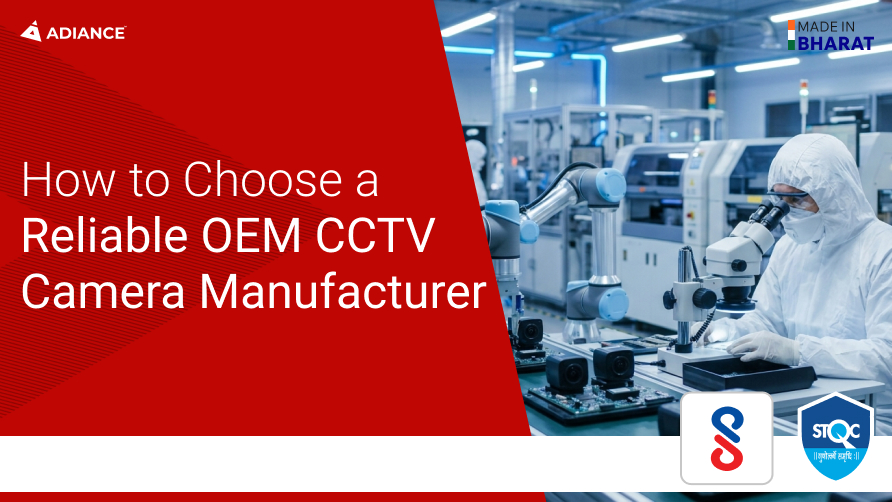
The manufacturer you pick will quietly decide your margins, your defect rates, your certification timelines and, ultimately, what your customers think of your brand. A camera that fails in the field carries your logo, not the factory's. That is why choosing anmanufacturer is the single most consequential sourcing decision a surveillance brand makes. The problem is that from the outside, most factories look the same. Every website promises "world-class quality" and "cutting-edge AI." The brochures are interchangeable. What separates a genuine manufacturing partner from an assembly shop only shows up when you ask harder questions. Having spent more than two decades on the manufacturing side of this industry, we know exactly which questions buyers should be asking, because serious buyers ask them of us. This guide walks through the evaluation criteria that actually predict a successful partnership.
Start With Track Record, Not Price
Price is the easiest thing to compare and the worst thing to compare first. A factory quoting 15% below market is usually saving that money somewhere you cannot see: recycled components, skipped burn-in testing, or no real engineering support after the PO is signed.
Track record is a better first filter. Look for a manufacturer with at least a decade of dedicated video surveillance experience, not general electronics assembly. Longevity in this specific industry means the factory has survived component shortages, the analog-to-IP transition, and shifting import regulations in the markets you sell into. Ask three things: how long have they built surveillance products specifically, which enterprise or government clients have trusted them with repeat orders, and can they name deployments in your target vertical.
Repeat institutional business is the strongest signal of all. Banks, railways, oil and gas companies and election authorities audit their vendors brutally before awarding contracts. A factory that has passed those audits repeatedly has already done much of your due diligence for you.
R&D Depth Decides What Your Brand Can Ship
A surveillance camera in 2026 is not a lens and a sensor in a weatherproof box. It is an edge computer. Buyers now expect AI analytics, cellular connectivity, cloud integration and mobile apps as standard, and your manufacturer either builds those capabilities in-house or you inherit their dependence on third-party licensors.
This distinction matters more than most buyers realize. A factory that integrates someone else's AI SDK cannot fix its bugs, cannot customize its detection rules for your vertical, and cannot promise the license will exist in three years. A factory with its own AI research team can do all three.
When you evaluate R&D capability, probe for specifics. Does the engineering team design its own PCBs or buy reference boards? Is the video analytics stack proprietary or licensed? Can firmware, mobile apps and the VMS be rebranded and customized for your market? How many patents does the factory hold, and do they solve real cost problems like bandwidth and storage, or are they decorative?
One practical test: describe a niche requirement from your vertical, say PPE detection for construction clients or ANPR for EV charging stations, and watch how they respond. A real R&D organization will discuss model training, false-positive rates andedgeversus cloud processing trade-offs. A trading company will just say yes to everything.
Quality Control You Can Verify, Not Just Read About
Every factory claims strict QC. Very few will show it to you in detail, and that gap is where your future RMA costs live.
A credible OEM CCTV camera manufacturer should be able to walk you through quality control at three stages. Incoming inspection covers sensors, lenses and modules verified against specification before they reach the line, because a counterfeit CMOS sensor looks identical until it fails at night. In-process control means automated SMT lines with optical inspection and a defect-rate target the factory will actually state as a number. If a manufacturer cannot tell you their PPM target, they do not measure it. Outgoing testing includes burn-in aging at elevated temperature, ingress testing for IP66 and IP67 rated housings, and surge testing for products destined for lightning-prone or high-temperature regions.
Ask for the numbers behind each stage, and ask to see the process live over a video call if you cannot visit. A factory proud of its line will happily point a camera at it. Also confirm you can appoint a third-party inspection agency before dispatch. Any hesitation on that point is a red flag worth acting on.
Certifications: The Difference Between Shipping and Seizure
Certifications are not marketing badges. They determine whether your product can legally enter and be sold in your market at all.
For most international markets, CE, FCC and RoHS are the baseline, along with ISO 9001 for the factory's quality management system and ONVIF conformance for interoperability. For India, the bar is higher and frequently misunderstood: CCTV cameras require BIS certification, and government and public-sector projects increasingly demand STQCevaluation, which tests cybersecurity posture, not just electrical safety.
Two questions cut through certification claims quickly. First, who holds the certificate? If the factory holds the BIS or type-approval licence in its own name, your compliance is secured at the source. If you are expected to certify imported goods yourself, you carry the cost, the delay and the liability. Second, are the certificates current and verifiable? Registration numbers can be checked in public databases. A reliable manufacturer will hand them over without being asked twice.
Communication, Lead Times and Supply Chain Resilience
Most OEM relationships do not fail on technology. They fail on a misread email about packaging dimensions, a firmware change nobody flagged, or a lead time that quietly slipped six weeks because the factory lost allocation on a chipset.
Evaluate communication during the inquiry phase, when the factory is on its best behavior. Do you get specific technical answers or vague reassurance? Does the team ask about your target market's climate, network conditions and installer ecosystem, or do they just push a catalog at you? A partner who asks good questions before the PO will keep asking them after it.
On supply chain, get commitments in writing on realistic lead times from PO to dispatch (45 to 60 days is a credible range for customized production; anything dramatically shorter deserves scrutiny), MOQ flexibility for pilot runs so you can validate the market before committing to volume, component sourcing strategy during shortages, and what happens after the sale: warranty terms, DOA replacement windows, firmware update policy and spare parts availability. That last point is where cheap suppliers become expensive. A camera brand lives or dies on after-sales support, and you can only pass on the support your manufacturer gives you.
The New Criterion: Data Sovereignty and Geopolitical Risk
Five years ago, this section would not have existed. Today it may be the most important one.
Governments across the US, Europe, Australia and India have restricted or banned surveillance equipment from certain foreign manufacturers over data security concerns. Procurement rules like the NDAA in the United States and public procurement orders in India now shape which hardware is even eligible for large contracts. If your product roadmap includes government, banking, critical infrastructure or enterprise clients, your manufacturer's country of origin and cloud architecture are now part of your product spec.
Ask where video data is processed and stored, whether the cloud infrastructure can be hosted in your customers' jurisdiction, and whether the hardware supply chain can withstand scrutiny from a security-conscious buyer. Brands that ignored these questions have already lost tenders they were technically qualified to win.
Where Adiance Fits Into This Checklist
We wrote this guide because these are the criteria we believe every buyer should hold every manufacturer to, including us. Here is how Adiance Technologies answers each one.
On track record: we have manufactured surveillance products in Ahmedabad, India since 2002, with clients including TATA, Reliance, Jio, ONGC, HDFC Bank, ICICI Bank, Western Railway and the Election Commission of India.
On R&D: we were the first in India to bring Edge-AI with 4G to CCTV, and our patented technology cuts bandwidth consumption by up to 70%, reduces cloud storage costs by up to 70%, and speeds up deployment by up to 90% through zero-touch provisioning. Our ArcisAI ecosystem, cameras, NVRs, STQC-certified VMS, cloud and ArcisGPT, is built in-house and fully white-labelable, from the app icon to the firmware boot screen.
On quality: our fully automated SMT lines process 1,000 PCBs per day across a 9-stage controlled workflow with a defect-rate target below 50 PPM, and a production capacity of 12 lakh (1.2 million) units per year.
On certifications: we hold BIS-ER, STQC, CE, FCC, RoHS, ONVIF and ISO 9001, in our own name.
On supply chain and sovereignty: 100% domestic manufacturing aligned with Make in India, 45 to 60 day lead times ex-Ahmedabad, India-hosted end-to-end encrypted cloud, and a structured 6-month roadmap from assessment to market launch.
Frequently Asked Questions
How do I verify whether a supplier is a real manufacturer or a trading company?
Ask for the business licence showing manufacturing in its registered scope, request a live video tour of the SMT line and testing areas, and check whether certifications are held in the company's own name. Trading companies typically resell a suspiciously broad range of products and hesitate to show a factory floor.
What lead time should I expect for OEM CCTV camera production?
For white-label orders on an existing design, expect roughly 3 to 4 weeks. For customized OEM production involving new tooling, firmware changes or certification work, 45 to 60 days from PO to dispatch is realistic. Be cautious of quotes far shorter than this for custom work.
What MOQ is typical for OEM CCTV cameras?
Most serious manufacturers offer small sample runs of 5 to 10 units per SKU for evaluation and field pilots, with production MOQs negotiated based on the level of customization. Always run a paid pilot before committing to volume.
Which certifications matter most for CCTV cameras?
CE, FCC and RoHS for international markets, ISO 9001 for the factory itself, and ONVIF for interoperability. In India, BIS certification is mandatory and STQC evaluation is increasingly required for government projects. Verify certificate numbers in public registries rather than trusting PDFs.
Can an OEM manufacturer integrate my own cloud platform or app branding?
A manufacturer with in-house software teams can rebrand the mobile app and web VMS, host the portal on your domain, customize firmware boot screens and expose REST APIs and webhooks for your platform. If a factory only offers a generic third-party app, your brand experience ends at the hardware.