A Future-Ready Surveillance System Is More Than Its Cameras
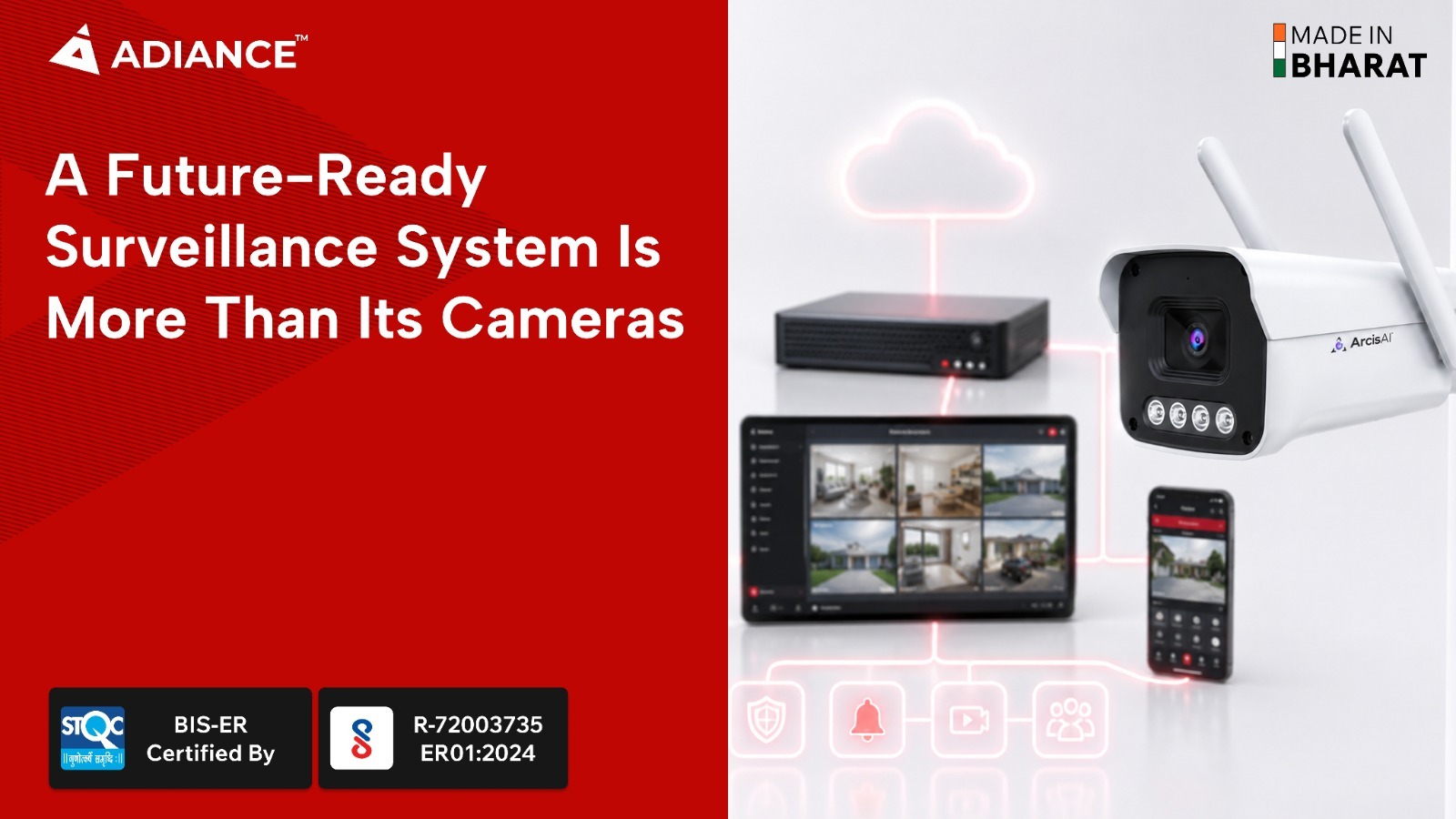
A surveillance system that performs flawlessly at installation can start falling behind within eighteen months. Not because it was poorly specified. Because the environment around it kept moving, camera counts grew, data volumes multiplied, integration needs changed, and the system wasn't designed to move with it. This is the quiet trap in most CCTV buying decisions. Procurement teams evaluate resolution, price per channel, and feature checklists at the moment of purchase. Few evaluate whether the system will still be worth having in year five or six, once the environment around it has changed twice over. A future-ready surveillance system isn't defined by what it can do on day one. It's defined by how well it's architected to scale, adapt, and keep delivering value as requirements shift. Getting this right at the sourcing stage saves years of rip-and-replace cycles later.
What "Future-Ready" Actually Means for a Surveillance System
Future-readiness is often marketed as a feature list: AI-enabled, cloud-connected, analytics-ready. In practice it's an architecture decision made before a single camera ships.
The global video surveillance market is on track to cross roughly $76 billion in 2026, and the AI-driven segment within it is growing far faster, in the range of 15 to 21% CAGR. That growth is a signal: buyers are no longer purchasing cameras. They're purchasing a platform that has to absorb several years of feature demand it can't fully predict yet.
A system qualifies as future-ready when it can scale without being rebuilt, process intelligence close to the source instead of only in a data center, manage data by relevance instead of by volume, and defend itself against the security risks that come with being permanently connected to a network.
Why Most Surveillance Systems Age Faster Than Expected
The cost of a fragmented stack
The traditional CCTV deployment is a stack of separate components: cameras from one vendor, a recorder from another, storage bolted on, and analytics licensed from a third party. Each piece ages on its own release cycle. When one vendor drops support or changes an API, the whole stack inherits the problem.
This is why so many "smart" camera deployments quietly stop being smart within a couple of years. The camera hardware is fine. The software layer around it stopped evolving, or the vendor who owned it moved on.
Systems designed as a single platform, where the camera, recorder, video management software, and AI layer are engineered by one team, don't carry this fragility. Feature requests, security patches, and firmware updates move through one accountable party instead of being negotiated across four contracts.
Scalability: Planning for 10x Camera Growth
Growth is where most surveillance deployments hit a wall. Adding cameras, raising resolution, or turning on heavier analytics all increase bandwidth and storage demand, and in a system that wasn't designed for it, costs rise faster than value.
A few numbers illustrate why this matters at scale:
- Every additional 4K camera on a network can add several megabits per second of continuous bandwidth draw, multiplied across every hour of every day.
- Cloud storage costs scale directly with retention period and resolution, so a policy of storing everything indefinitely gets expensive quietly and fast.
- Deployment and provisioning time compounds linearly with camera count unless the onboarding process is automated.
Modern compression and edge-processing techniques exist specifically to break that curve. As an example from our own manufacturing work at Adiance, patented bandwidth optimization built into our camera line cuts bandwidth consumption by up to 70% and cloud storage costs by a similar margin, while zero-touch provisioning speeds up deployment by up to 90%. The point isn't the specific numbers, it's that scalability has to be engineered into the compression and provisioning layer, not solved later with a bigger server bill.
Edge AI vs Cloud AI: Where Should Decisions Happen
Centralized, cloud-only processing means every detection event waits on a round trip to a server. For a lot of use cases that's an acceptable delay. For an intrusion alert, it isn't.
Edge AI moves detection onto the camera or a local device, so classification (a person, a vehicle, a restricted-zone breach) happens on-site in real time, independent of network conditions. Cloud AI, by contrast, is better suited to heavier, cross-site tasks: forensic search across weeks of footage, face or license-plate matching against a watchlist, or aggregating analytics from dozens of locations into one dashboard.
The strongest architectures don't pick one. They use edge processing for instant, local decisions and cloud processing for aggregation and deep analysis. Adiance was the first manufacturer in India to bring Edge-AI with 4G connectivity to CCTV, and our current camera line runs up to eight built-in edge AI models directly on the device, so real-time detection doesn't depend on cloud connectivity at all.
Data Strategy: From Storage to Search
Recording everything isn't the same as understanding anything. Most footage from a standard deployment is never watched unless an incident forces someone to go looking for it days later, by which point the value of "seeing it live" is gone.
A future-ready data strategy shifts the goal from accumulation to precision:
- Event-based recording flags what matters instead of treating every frame as equally important.
- AI-driven tagging and indexing make footage searchable by object, person, or event rather than only by timestamp.
- Vertical-specific analytics (tuned differently for a retail floor than for an EV charging site or a BFSI branch) reduce false positives by understanding context, not just motion.
This is the layer where cloud AI add-ons, people counting, heat maps, forensic search, earn their keep. They turn a growing archive into a searchable asset instead of a storage liability.
Cybersecurity and Firmware Ownership
A connected camera is, functionally, a small networked computer. That means it inherits every risk that comes with being permanently online: firmware vulnerabilities, unpatched software, and unclear data residency.
Certification frameworks are catching up to this reality. In India,BIS registration covers electrical and hardware safety, while STQC evaluation for the video management software layer specifically tests cybersecurity posture, not just electrical compliance. A camera can be certified while the software managing it is not, which is why buyers increasingly ask about both layers, not just the hardware.
The deeper question worth asking any manufacturer is who actually owns the firmware. If it's licensed from a third party, a security patch means waiting on someone else's priority queue. When the manufacturer writes its own firmware and its own AI, patches and fixes move on the manufacturer's own timeline rather than a vendor's backlog.
Physical Reliability: Built for the Field, Not the Demo
A future-ready system still has to survive conditions the demo unit never sees: a rooftop enclosure in peak summer, a monsoon-soaked junction box, a voltage spike from a nearby transformer.
This is where ingress protection ratings (IP66/67), sustained-temperature testing (typically 50 to 60°C for tropical deployments), and surge protection (commonly rated to 4KV for lightning-prone regions) stop being spec-sheet decoration and start being the difference between a camera that survives its first monsoon and one that doesn't. Defect rate targets matter here too. A manufacturer that can state a specific PPM (parts-per-million defect) target and back it with burn-in aging tests is measuring reliability. One that can't, isn't.
How to Evaluate a Future-Ready Surveillance Partner
Before signing with any CCTV manufacturer or OEM/ODM partner, it's worth asking a short set of direct questions:
- If I increase camera count 10x next year, does my bandwidth and storage cost scale proportionally, or does the architecture absorb it?
- Does detection happen on the camera itself, or does every alert depend on a live connection to a server?
- Who owns the firmware, and who is accountable when a vulnerability is disclosed?
- Can I add advanced AI capabilities later without replacing cameras already deployed in the field?
- Is the hardware rated and tested for the actual environmental conditions it will operate in, not just the conditions of a showroom demo?
A supplier who can answer all five with specifics, numbers, certifications, and named technology, is building for the long deployment life surveillance actually requires. A supplier who answers only the first question with "our cameras have great resolution" is selling a product, not a future-ready system.
Building This at Adiance
Adiance Technologies is a full-stackOEMand ODMmanufacturer of intelligent CCTV surveillance, based in Ahmedabad, India, and this future-ready framework is how we engineer our own product line, the ArcisAI ecosystem.
Cameras, NVRs, an STQC-certified VMS, cloud, and an AI layer including ArcisGPT and ABD (ArcisAI Bridge Device, which connects ONVIF-compatible cameras into our VMS) are built by one in-house engineering team rather than stitched together from four vendors, so partners who white-label this stack inherit a roadmap that keeps moving under their own brand. Our patented bandwidth and storage optimization cuts network and cloud costs by up to 70% and speeds deployment by up to 90% through zero-touch provisioning, on manufacturing capacity scaling toward 12 lakh (1.2 million) units a year from an in-house SMT line. Hardware carries BIS-ER certification (licence R-72003735) and IP66/67-rated, surge-tested builds, backed by an STQC-certified VMS and India-hosted, end-to-end encrypted cloud infrastructure, with firmware and AI written and owned in-house rather than licensed from a third party.Partner with Adiance for OEM/ODM manufacturing:https://www.adiance.com/
FAQs
What does "future-ready" mean for a CCTV or surveillance system?
It means the system is architected to scale, adapt, and absorb new requirements (more cameras, new analytics, changing compliance rules) without being rebuilt from scratch. It's an architecture property, not a single feature.
Is edge AI or cloud AI better for video surveillance?
Neither replaces the other. Edge AI handles real-time, on-site detection and works through connectivity outages. Cloud AI handles heavier cross-site analytics like forensic search and multi-location dashboards. Most future-ready systems use both.
How much can AI-driven video analytics reduce bandwidth and storage costs?
It varies by implementation, but patented compression and edge-processing approaches can realistically cut bandwidth and cloud storage consumption by up to 70%, since only relevant events and clips are transmitted instead of continuous raw video.
What certifications should I look for in an OEM CCTV manufacturer?
At minimum, BIS registration for hardware safety and, for the Indian market, STQC certification for the video management software layer, since VMS security is where a lot of "certified hardware" deployments actually remain exposed. For export markets, CE, FCC, RoHS, and ONVIF conformance are standard baselines.
How often should a surveillance system be upgraded?
With a properly architected platform, hardware typically has a useful life of five to seven years, and software and AI capability should be upgradable within that window without replacing the cameras. Systems built as fragmented, single-vendor products tend to need full replacement much sooner.