Edge AI vs. Cloud AI in Surveillance: Which Is Right for Your Business?
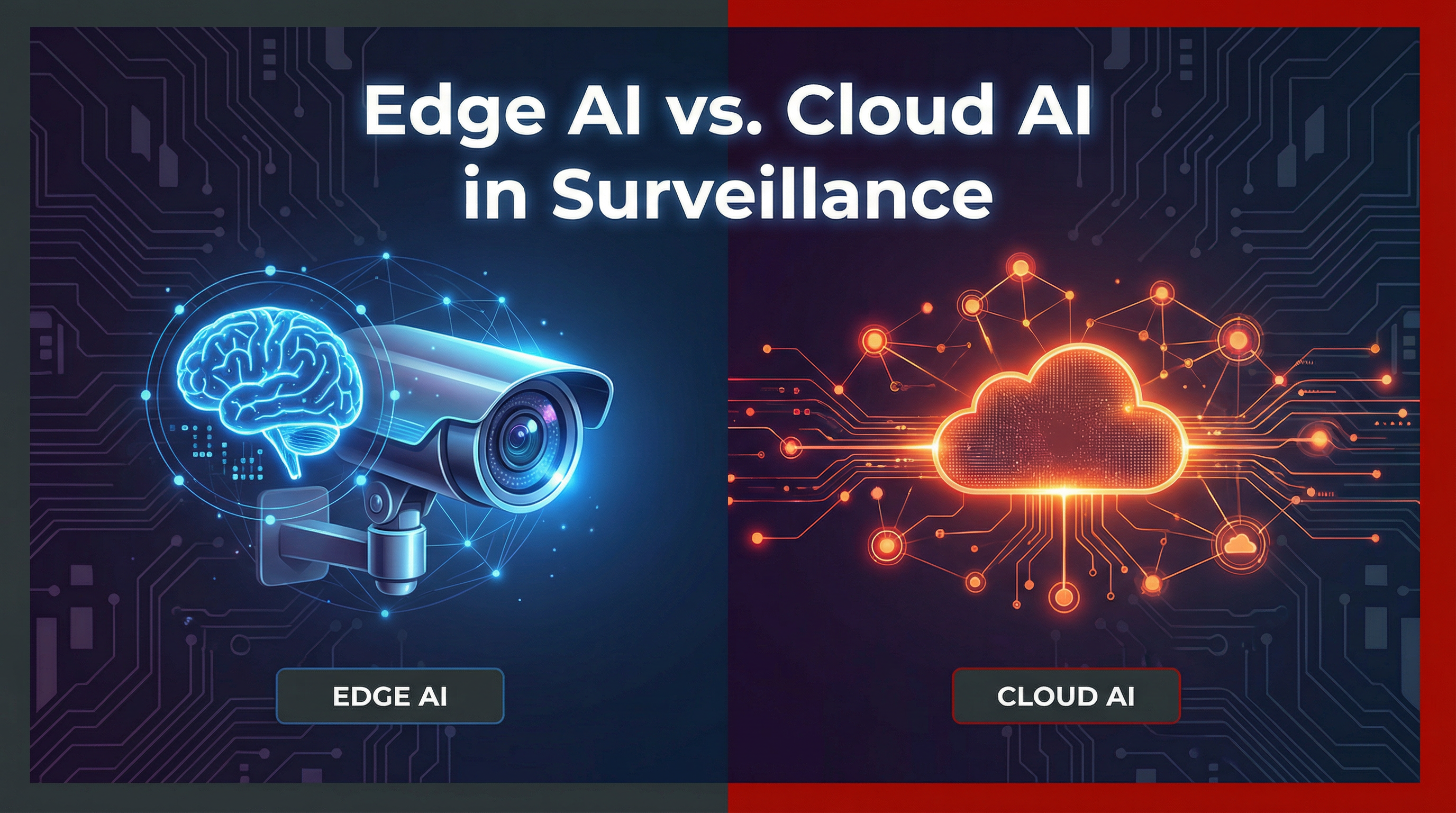
In the rapidly evolving world of video surveillance, the debate between Edge AI and Cloud AI is a critical one for businesses looking to enhance their security infrastructure. Both architectures offer powerful capabilities for analyzing video data, but they do so in fundamentally different ways.
What is Edge AI?
Edge AI refers to the processing of artificial intelligence algorithms directly on the device where the data is generated — in this case, the CCTV camera itself. Our S-Series Edge AI cameras, for example, have powerful System-on-Chip (SoC) processors that can run analytics like facial recognition, license plate reading (ANPR), and intrusion detection in real-time, on the device.
Advantages of Edge AI
Reduced Latency: Because data is processed on the edge, alerts and actions are instantaneous. For applications like access control or perimeter security, this real-time response is crucial. There is no delay from sending video to the cloud and waiting for a response.
Lower Bandwidth Costs: Edge AI cameras only need to send small packets of data (e.g., an alert, a license plate number) to the cloud, rather than a continuous, high-resolution video stream. This dramatically reduces bandwidth consumption and associated costs, especially for large-scale deployments with hundreds of cameras.
Enhanced Privacy and Security: By processing video data locally, Edge AI minimizes the transmission of sensitive information over the internet. The full video footage can remain on-premise, reducing the risk of data breaches and helping to comply with strict privacy regulations like GDPR.
Improved Reliability: An Edge AI system can continue to operate even if the internet connection is lost. The cameras will keep analyzing video and storing events locally, ensuring that your security system is always on.
What is Cloud AI?
Cloud AI involves sending video data from the cameras to a centralized cloud server for processing. These servers, running in massive data centers, have virtually limitless computational power and can run highly complex and sophisticated AI models that may be too resource-intensive for an edge device.
Advantages of Cloud AI
Massive Scalability and Power: The cloud offers unparalleled processing power. You can run complex analytics across video feeds from thousands of cameras simultaneously, identifying large-scale patterns, trends, and anomalies that would be impossible to detect at the edge.
Centralized Management and Updates: With a cloud-based system, you can manage all your cameras, update AI models, and adjust settings from a single dashboard, anywhere in the world. This simplifies maintenance and ensures all devices are running the latest software.
Cost-Effective for Complex Analytics: While sending continuous video can be bandwidth-intensive, the pay-as-you-go model of cloud computing can be more cost-effective than purchasing and maintaining high-powered edge devices if you only need to run complex analytics periodically.
Data Aggregation and Archiving: The cloud provides a centralized and virtually unlimited repository for your video data. This is ideal for long-term storage, historical analysis, and training new, custom AI models on your specific data.
The Hybrid Approach: The Best of Both Worlds
For many modern surveillance applications, the most effective solution is not a choice between edge or cloud, but a hybrid approach that combines the strengths of both. In a hybrid model, Edge AI cameras act as the frontline, performing real-time analysis for immediate threats (e.g., intrusion detection, loitering alerts). The Cloud provides strategic, long-term intelligence — the edge devices can pre-filter data, sending only relevant events or metadata to the cloud for deeper analysis, business intelligence, or long-term storage.
This approach gives you the real-time response and bandwidth savings of the edge, combined with the powerful analytics and centralized management of the cloud. This is the strategy we recommend to many of our OEM partners.
Comparison: Edge AI vs Cloud AI vs Hybrid
Edge AI: Processing on-device, very low latency, low bandwidth, high privacy, works offline. Best for immediate alerts, access control, low-bandwidth areas. Cloud AI: Processing on remote server, higher latency, high bandwidth, lower privacy. Best for large-scale data analysis, business intelligence, centralized management. Hybrid AI: Both on-device and remote processing, low latency for initial alerts, low-to-medium bandwidth, high privacy. Best for most modern, flexible deployments.
Conclusion
Choosing between Edge AI and Cloud AI depends entirely on your specific use case, budget, and infrastructure. If you require real-time alerts and operate in an environment with limited bandwidth, Edge AI is the clear winner. If you need to analyze massive datasets from multiple locations and require centralized control, the cloud is more suitable. For most of our OEM/ODM partners, we recommend a hybrid strategy. It provides the most flexible, scalable, and resilient solution, delivering immediate, actionable intelligence from the edge while leveraging the strategic power of the cloud.
Ready to build your next-generation AI surveillance product line? Contact Adiance today to learn how our OEM/ODM manufacturing services and deep engineering expertise can help you deliver the perfect solution for your market.
Further Reading & Industry Resources
For more information on the topics discussed in this article, visit these authoritative sources: NIST AI Risk Management Framework (https://www.nist.gov/artificial-intelligence/executive-order-safe-secure-and-trustworthy-artificial-intelligence) | IEEE Edge Computing Standards (https://standards.ieee.org/industry-connections/edge-intelligence/) | Gartner: Edge Computing Technology Trends (https://www.gartner.com/en/information-technology/glossary/edge-computing)