CCTV Camera PCB Diagram: Components, Design, and Manufacturing Insights
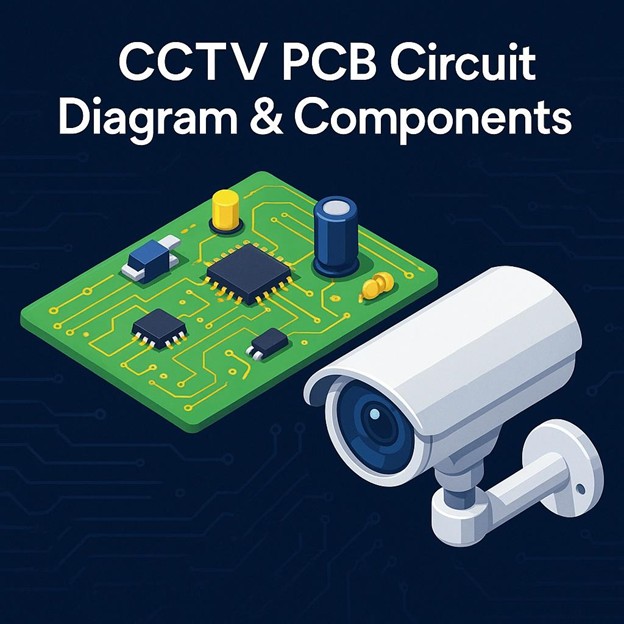
Published Thu Nov 27 2025

Hardik Sanghvi

CCTV Camera PCB Diagram: Components, Design, and Manufacturing Insights

Most modern electronics—from smartphones and drones to factory robots—depend on a compact printed circuit board that fuses sensors, power, and computing into one coordinated system. Security cameras are no different. Open one up and you’ll find everything converges on a single CCTV PCB diagram. That tiny board is the “brain” that keeps the whole setup alive. Without it, the lens, the image sensor, or even the AI features don’t amount to much.

So when people ask, “What exactly sits on a CCTV camera circuit board? How does a cctv camera board handle image processing, storage, and networking?” I always say: let’s keep it simple and unpack it step by step. That’s exactly what I’ll do here.

If the cctv pcb board is designed well, you’ll get clear footage, smooth AI detection, and reliable 24×7 performance. If not, you may face noise, overheating, or signal loss. That’s why understanding the cctv camera printed circuit board matters for anyone in security, electronics, or OEM manufacturing.

What is a CCTV Camera PCB and What Does it Do?

In simple terms, a cctv camera printed circuit board is the base plate that holds all the electronic components together. It’s like a miniature city — processors, sensors, memory, power modules — all connected by copper pathways (like roads).
A camera circuit board doesn’t just “sit there.” It actively processes images, manages power, runs AI algorithms, and sends the video over PoE, Wi-Fi, 4G, or 5G. So, whenever you see a cctv camera circuit diagram, what you’re really looking at is how this PCB makes everything work in harmony.

Which Components are Essential on an AI CCTV PCB Board?

So, what exactly sits on a security camera printed circuit board? Let me walk you through the essentials you’ll always find in a camera circuit.

Image Sensor

This is the eye of the system, converting light into electronic signals. The sharper the sensor, the better your night vision and overall clarity. Proper shielding and clean analog power help the sensor deliver stable, low-noise images.

Microcontroller / Processor

The “brain” handles compression, video encoding and increasingly AI tasks like motion detection or face recognition. It coordinates peripherals and ensures streams stay smooth under load. Firmware optimization keeps latency low and features responsive.

Memory Modules

Two types here: RAM to process live video and flash memory to store firmware and updates. Adequate RAM prevents dropped frames during peak activity. Reliable flash ensures safe upgrades and fast boot behavior.

Power Circuit

Every cctv board needs stable voltage across all rails. These circuits ensure your camera doesn’t crash during spikes or fluctuations. Good regulation also reduces heat and extends component life.

Network / Wireless Modules

Depending on the model, you’ll find PoE chips, Wi-Fi modules, or SIM slots for 4G/5G connectivity. These provide the data paths for streaming and remote access. Correct RF layout and magnetics improve range and link stability.

LEDs, Audio & Other Drivers

Infrared LEDs power night vision while audio codecs handle microphones and speaker outputs. Drivers regulate current so IR illumination stays consistent. Balanced design avoids noise leaking into the video path.
When you look at a cctv camera pcb circuit diagram, all of these parts are laid out logically to avoid interference and keep the system compact. Clear placement and short routes help signals stay clean. That integration is what turns components into a dependable camera.

What Specs Matter Most for an AI CCTV Printed Circuit Board?

Not all cctv pcb boards are the same. Their specs change based on whether they’re used in a small home camera or a rugged outdoor PTZ unit.
Here are some common specifications:
  • Layers: Most CCTV printed circuit boards have 4–12 layers. More layers = better performance.
  • Material: FR-4 is common, but high-end boards use heat-resistant laminates.
  • Signal Quality: Controlled impedance ensures clear video signals without distortion.
  • Heat Tolerance: Outdoor cameras need PCBs that survive up to 125°C.
  • Compliance: Standards like BIS/TEC (India), RoHS (global), and NDAA (US) keep cameras eligible for tenders.
  • Power Budget: Define PoE/PoE+ class and peak/average current with ~20% headroom for IR LEDs and surges.
  • High-Speed Interfaces: Specify DDR/MIPI length-matching, skew limits, and impedance for error-free video.
  • Storage Endurance: MicroSD/cloud write cycles, TBW, and wear-leveling to handle continuous recording.
  • Environmental & Ingress: Operating temp/humidity ranges and IP rating (e.g., IP66/IP67) for outdoor use.
  • Mechanical: Board size, mounting holes, connector keepouts, and lens/sensor alignment tolerances.
  • Firmware & OTA: Secure boot, dual-bank updates, rollback, and signed firmware requirements.
  • Documentation: Controlled BoM with alternates, PLM lifecycle status, and revision/change logs.

How Does a Security Camera B Diagram Move from Schematic to Shipment?

So, how does a CCTV camera printed circuit board actually come to life? Here’s the typical journey:

Schematic Design

Engineers create the cctv camera circuit diagram, mapping every connection. They define power rails, interfaces, and protections so every block talks cleanly. This blueprint aligns components, firmware needs, and test hooks from day one.

PCB Layout

Components are placed, traces are routed, and simulations are run. Impedance, length matching, and return paths are validated to protect high-speed and analog signals. The result is a compact CCTV board that balances thermal, EMI, and manufacturability.

Fabrication

Layers of copper and fiberglass are etched and laminated to form the board stack-up. Controlled impedance and tight tolerances ensure signals behave as designed. This turns the digital plan into a physical cctv board substrate ready for assembly.

Assembly

Processors, sensors, and connectors are mounted using SMT lines. Reflow profiles are tuned, BGAs are X-rayed, and AOI checks placement quality. The populated camera circuit board moves forward only when solder integrity is verified.

Testing

Boards are tested for power stability, video quality, and AI function reliability. Functional checks validate encoding, networking, storage, and night-vision subsystems. Burn-in and environmental sweeps confirm the security camera pcb board is field-ready.

Certification

Compliance with global standards ensures the security camera printed circuit board is ready for global markets. EMC, safety, and environmental tests de-risk deployment in varied regions. Documentation and traceability lock the design for scale production.
This process ensures that every camera circuit board leaving the factory is stable, safe, and long-lasting.

What Makes Adiance the Trusted AI CCTV Camera PCB Provider?

Adiance wins trust where it counts on the line and in the field. With 18+ years in India’s toughest deployments and 100,000+ cameras rolled out nationwide, we treat cctv camera pcb manufacturing as engineering, not procurement. Designs are co-built around your optics, AI load, and enclosure, then proven through EVT/DVT/PVT, power stress, and pre-compliance EMI/EMC. BIS, TEC, NDAA considerations are baked in from day one—so audits don’t become post-launch surprises.
Clients across smart cities, PSUs and enterprise OEMs choose us because a custom CCTV PCB must run 24×7 and keep passing audits quarter after quarter. Our Made in India footprint pairs local agility with global quality - tight vendor networks, alt-part strategies, and in-house firmware/OTA pipelines - so pilots scale to mass production without quality drift. In short: you don’t just get a cctv pcb board; you get a partner ready to defend your performance in the lab, on the pole, and in the RFP.

Conclusion

The security camera pcb diagram may look technical at first glance, but once you break it down, it’s clear this board is the backbone of every surveillance camera. From the camera circuit and components to manufacturing and testing, everything about the cctv camera pcb ultimately decides how effective the camera will be in the field.
For businesses planning to scale in security solutions, the differentiator isn’t just parts - it’s the process. Choose a partner that co-designs to your roadmap, validates for your real-world environments, and supports the full lifecycle so your cctv camera printed circuit board ships on time, scales cleanly, and stays AI/cloud-ready with compliance handled. Adiance focuses on that end-to-end discipline, helping your custom CCTV PCB move from schematic to stable field performance with fewer iterations and a smoother certification path.

FAQs

A cctv camera board manages power, processes video signals, and connects the camera to networks. With our boards, you get stable performance and clear video output.

Yes, we offer custom CCTV printed circuit board services designed for different camera types. With our solutions, brands can optimize image clarity, reduce interference, and meet global certifications.

We test each CCTV security camera printed circuit board with simulations, thermal checks, and live prototypes. With our system, clients get zero-defect PCBs ready for scaling.

Because we combine advanced cctv camera pcb manufacturing with compliance, local production, and scalable solutions. With our system, you get more than a board—you get a trusted partner.

Table of Contents
  • What is a CCTV Camera PCB and What Does it Do?

  • Which Components are Essential on an AI CCTV PCB Board?

  • What Specs Matter Most for an AI CCTV Printed Circuit Board?

  • How Does a Security Camera B Diagram Move from Schematic to Shipment?

  • What Makes Adiance the Trusted AI CCTV Camera PCB Provider?

  • Conclusion

Send Us a Message
Chat with us on WhatsApp

Looking for a trusted OEM/ODM CCTV manufacturing partner?

Request a Quote